
The Model Didn’t Learn. The Rulebook Did: Memento 3 and the Case for Memory Outside the Weights
Published:
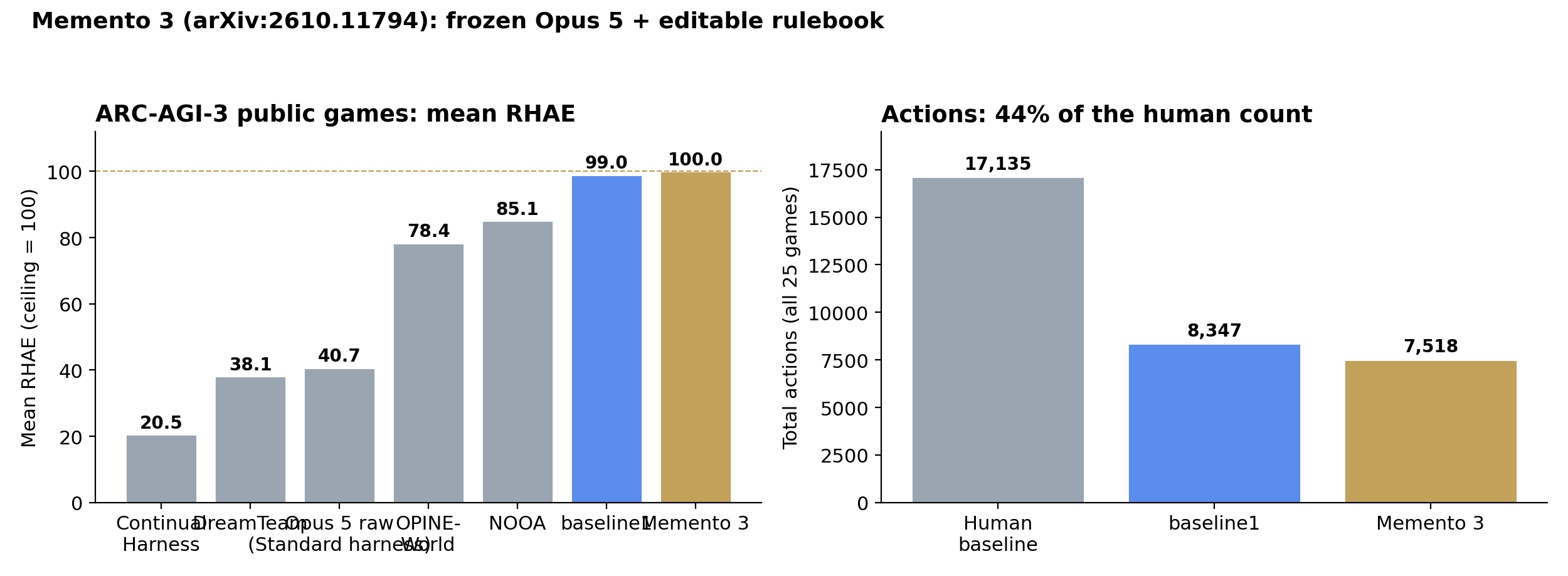
A frozen Claude Opus 5 just scored 100.0 on ARC-AGI-3 — 59.3 points above its own raw score. The weights never changed. What changed was a Markdown file the agent rewrites as it plays.
That is the headline result of Memento 3 (Haoyu Zhao, Zhengxu Yu, Zhiyuan He, Meng Fang, Rasul Tutunov, Haitham Bou-Ammar, Weilin Luo, Jun Wang — UCL, Huawei Noah’s Ark Lab UK, University of Liverpool), posted to arXiv on October 8, 2026. The paper’s real contribution is not the score. It is a concrete architecture for learning that lives outside the weights — and an unusually honest set of tables showing exactly how much of the win belongs to that architecture.
What happened
On all 25 public ARC-AGI-3 games, the single-model Memento 3 agent:
- Cleared every level of every game, reaching the mean Relative Human Action Efficiency (RHAE) ceiling of 100.0.
- Used 7,518 actions, 44% of the 17,135-action human baseline (per-game ratio 0.20–0.67, median 0.42).
- Beat raw Claude Opus 5 on the ARC Prize Standard harness (40.7 mean RHAE) by 59.3 points.
The backbone is Claude Opus 5 running inside Claude Code at extra-high reasoning effort. Every baseline number comes from that system’s official ARC Prize scorecard, so the columns are counted the same way.
How it works: Code as Model
The agent maintains two representations of what it believes about the world:
- A natural-language rulebook (a Markdown file) — persistent semantic memory holding revisable hypotheses about objects, actions, dynamics, and goals. Unknown aspects stay deliberately underspecified.
- An executable Python module compiled from the rulebook — used for prediction and planning.
The loop is observe → reflect → revise the rule → compile → verify. A rule-level change is written to the rulebook first, then the code is refined; an implementation-only diagnosis leaves the rulebook intact and fixes only the code.
Two verification gates decide whether an update is accepted:
- Cell-exact replay: the executable must reproduce every observed transition in the interaction history. This is the hard gate.
- Rulebook fidelity: the LLM judges whether the code is faithful to the rulebook. This is the soft gate — the same model grading its own homework, which is worth naming plainly.
Two more design choices matter as much as the loop:
- Git memory. The rulebook and compiled modules live in a version-controlled workspace, committed after each iteration. The agent can inspect earlier versions, diff two rulebooks, and restore an executable a later edit broke. The learning trajectory is addressable, not just the latest snapshot.
- Population. A generalization holds N rulebook–executable pairs in parallel against a shared interaction history. Different models guide exploration; any pair whose prediction conflicts with an observation gets repaired. This is an explicit answer to the version-space problem: finite evidence leaves many hypotheses consistent with the past but disagreeing about the future, and committing to one can steer exploration away from the evidence that would falsify it.
The Pong case study: the same mechanism does control
ARC-AGI-3 is discrete planning. The paper asks whether the same rulebook mechanism supports feedback control, where decisions update continuously from new observations. In Atari Pong (ALE, frame-skip 4), the learned model drives a feedback controller:
- 21:0 wins in all three evaluated episodes with different openings (3,358 / 4,014 / 5,039 actions).
- 9,504 emulator frames of learning cost — vs ~400,000 for EfficientZero V2 (about 42×) and 200M for model-free RL baselines (about 21,000×).
- The same LLM with no world model, one call per frame and no persistent memory, scores −19. Human average is 14.6.
- During evaluation the controller is fixed and makes zero LLM calls — the knowledge has been fully compiled out of the model and into the rulebook + code.
The honest read: what the rulebook actually bought
This is where the paper earns trust — and where a careless summary would oversell it.
The +59.3 gap is vs the raw model, not vs the field. The closest prior system, Rodionov’s baseline1, already scores 99.0 RHAE and clears all 25 games in 8,347 actions. Memento 3’s margin over the best prior harness is +1.0 RHAE and 10% fewer actions (7,518 vs 8,347). Baseline1 also maintains a persistent, verified Python world model. The paper’s related-work section says so explicitly. What Memento 3 adds on top is the natural-language rulebook layer, the population extension, Git memory, and the Pong control transfer — not the idea of a code world model itself.
The ablation is small. Removing the rulebook (keeping code model, verifier, harness, backbone identical) was tested on 3 games (one per difficulty band): 617 vs 677 actions (−9%) and 678 vs 830 agent turns (−18%), with completion held constant. Real, but a 3-game ablation, and the paper is upfront that runs are expensive.
The population result is one game. N=2 on wa30 (the game with the largest human baseline): 899 → 597 actions (−34%) at RHAE 100. One game, one comparison — promising, not established.
Public games only. All results are on the 25 public games of a 135-environment benchmark. There is no held-out or private-set result in the paper. ARC-AGI-3’s public games are the ones every system in Table 1 is measured on, so the comparison is fair — but “solves ARC-AGI-3” means the public set, not the benchmark’s full distribution.
Cost is undisclosed. The paper notes each Claude Code run incurs “substantial time and monetary cost” but reports no token or dollar figures. Action-efficiency is not cost-efficiency: an agent that uses fewer environment actions while burning extra-high-effort reasoning on every revision may still be the expensive option. Do not quote 44%-of-human as a cost saving.
So what do you do differently on Monday?
1. Give stateful agents a persistent rulebook + a replay verifier — not a longer prompt. If your agent touches a stateful environment (a repo, infra, a data pipeline), its durable state should be a human-readable rule file plus an executable model of that environment, with a hard gate: a model update ships only if it replays every recorded transition exactly. The LLM judging its own code faithful to its own rulebook is a soft gate — keep it, but never let it be the only gate. Threshold: adopt this the moment the same agent failure recurs a second time in one week. A lesson that lives only in context will be re-learned every session, at full price.
2. Measure re-learning cost as a line item. Count how many agent turns your system spends re-deriving facts it derived before. Memento 3’s ablation puts a number on the pattern: the rulebook saved 9% of actions and 18% of agent turns on the tested games. Run your own version: pick one recurring workflow, log turns spent on already-known facts for a week, and promote any lesson that recurs more than twice into a verified rulebook entry. If re-learning exceeds ~15% of agent turns, the memory layer is the bottleneck, not the model.
3. When one hypothesis dominates exploration, run two world models on shared evidence. The population trick — N=2, shared history, repair on conflict — cut actions 34% on the single tested game. Use it when a single early hypothesis is steering the whole trajectory: keep two competing models, let them disagree, and let shared evidence kill the wrong one. Do not pay for N>2 until N=2 shows a measured win on your own tasks.
The debatable claim
If a frozen model plus an editable, versioned rulebook matches a retrained one, the model is no longer the whole product. The versioned world model — inspectable, diffable, revertible, verifiable by replay — is. Retraining moves knowledge into weights you cannot read. The rulebook moves it into text you can audit, and into code you can execute without the model at all — as the Pong controller demonstrates.
The counterargument is real: all of this rides on a frontier model doing the proposing, the revising, and the judging. The rulebook is only as good as the frozen brain writing it, and the soft self-judgment gate is a hole a bad revision can walk through. Memento 3 does not eliminate that dependence. It makes the dependence auditable.
Caveats, collected
- Author-reported preprint, not independently replicated. All baseline numbers are from official ARC Prize scorecards.
- 25 public games only; no private/holdout evaluation.
- Ablation: 3 games. Population: 1 game. Pong: 1 game, 3 episodes, with learning stopped at the first 21:0 win.
- No token or dollar cost reported; action-efficiency ≠ cost-efficiency.
- The fidelity gate is the LLM judging its own code.
Sources
- Memento 3: Model-Based Recursive Self-Improvement through Reflective Rulebooks — arXiv:2610.11794 (submitted Oct 8, 2026): https://arxiv.org/abs/2610.11794
- ARC-AGI-3 benchmark paper — arXiv:2603.24621: https://arxiv.org/abs/2603.24621
- All numbers in this article are from Tables 1–5 and Sections 4–5 of the Memento 3 paper unless noted.
Share on
Twitter Facebook LinkedIn☕ Buy me a coffee! 💝
If you found this article helpful, consider buying me a coffee to support my work! 🚀