
Harness-Agnostic Skills: The Plugin Format War Is a Versioning Problem
Published:
Everyone building an in-house coding harness hits the same wall. It is not the model. It is the plugin layer.
You write a Claude plugin — skills, hooks, MCP servers, a few scripts — and it works. Then someone asks for Codex support, then Muse Code, then the internal harness your company is building to stop paying three vendors for the same tokens.
And the portability story turns out to be two layers deep. Then it stops.
What actually ports
Two things port. Everything else is per-vendor.
SKILL.md ports. Agent Skills is an open standard published by Anthropic in December 2025. Codex, GitHub Copilot, Cursor, Gemini CLI, and 40+ other products read it. A skill written to the standard’s core fields — name, description, body — runs unchanged across them.
MCP ports. The tool protocol is universal, with 97M+ monthly SDK downloads reported in a March 2026 portability survey.
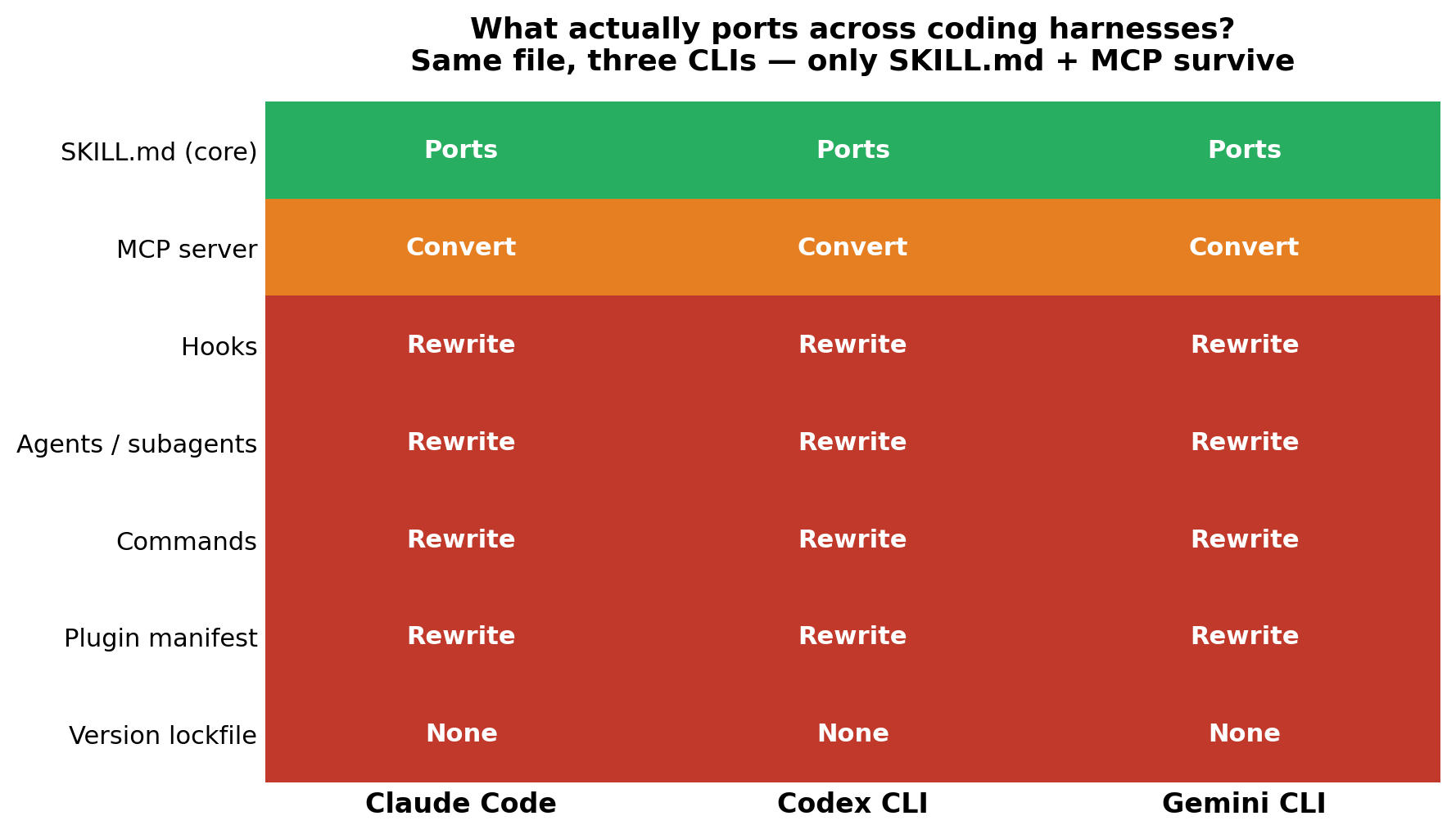
The rest does not:
| Component | What happens on port |
|---|---|
| Plugin manifest | Rewrite — Claude, Codex, and Gemini each want their own |
| Hooks | Rewrite — different event names, matchers, schemas |
| Agents / commands | Rewrite — no auto-import equivalent |
| Versioning | Doesn’t exist — no version field, no lockfile |
The versioning gap is the worst one. The Agent Skills standard has no version field. Community repos bolt one on via metadata.version plus a registry JSON plus changesets — every team invents its own.
MCP has no lockfile either. The dominant install pattern is npx -y pkg@latest, which resolves to whatever is newest at install time. A recent test that installed and started 12,915 MCP servers found 41% never answered at all.
State of the art: portable content, unportable packaging, no versioning.
Why this bites hardest for in-house harnesses
Building your own harness means inheriting all three problems at once.
Your harness must consume the internal skills your teams already wrote for Claude and Codex. Your users need the exact bundle version you tested — not whatever latest resolved to on their laptop this morning.
And your RAG pipeline must index something stable. If it indexes the live repo, retrieval returns whatever HEAD happens to be. Then “which version answered that question” becomes unanswerable.
This is a distribution problem wearing an AI costume. We solved it for code with package managers and lockfiles. Skills are code — Markdown plus scripts plus server configs plus CLI dependencies — and they deserve the same treatment.
The 3-layer fix
SKILL.md + scripts + references"] --> L2["Layer 2: generated adapters
one generator, every vendor manifest"]; L2 --> L3["Layer 3: pinned bundle
tarball + lockfile with digests"]; L3 --> H1["Claude Code"]; L3 --> H2["Codex"]; L3 --> H3["Gemini CLI"]; L3 --> H4["In-house harness"]; L3 --> R["RAG index"];
Layer 1: neutral content. One canonical repo per skill family. Each skill is SKILL.md (standard core fields only, no vendor extensions in the body), plus scripts/, references/, assets/.
Scripts declare their runtime explicitly: uv run --with pinned==x.y.z, npx -y pkg@exact-version, or a container image digest. No bare python script.py. No bare npx pkg. No vendor-specific frontmatter in the canonical copy.
Layer 2: generated adapters. One generator reads the canonical skill and emits each harness’s packaging: .claude-plugin/plugin.json, .codex-plugin/plugin.json, gemini-extension.json, and the in-house harness’s own manifest.
Adapters are build artifacts, never hand-edited. If a vendor changes its manifest schema, you change the generator once. The moment someone hand-edits a generated adapter, you have two sources of truth — and the portability story is dead.
Layer 3: pinned bundles. The shippable unit is a content-addressed bundle — a tarball or OCI artifact — plus a lockfile. Every skill pinned by version. Every MCP server pinned by exact version and digest. Every CLI dependency pinned. Every script runtime pinned.
The harness installs a bundle version, not a repo. A skills doctor command verifies the installed bundle hash against the lockfile and fails loudly on drift. Community tooling is already pointing this way: SurfacePin locks exact hashes of an MCP server’s tool surface and fails CI on silent drift.
And the RAG layer: index the pinned bundle, not the live repo. Retrieval returns the skill, its version, and its dependency closure. When a user asks “why did the agent do that,” the answer includes the bundle version — the same way a stack trace includes the build.
What this does not solve
- Behavioral drift. A pinned bundle guarantees the same files, not the same model behavior. Model updates behind the API still move outputs. Pin the model version too, where the provider allows it.
- Hook semantics. Generated adapters translate packaging, not semantics. A PreToolUse hook gating on a Claude-specific tool name has no exact Codex equivalent. Keep hooks minimal and harness-neutral, or accept per-harness hook code as the one sanctioned exception.
- The standard may still arrive. A neutral skill-bundle manifest (content + deps + lockfile) is the obvious next standard, and the Agentic AI Foundation now stewards both MCP and Skills. If it ships, Layer 2 gets thinner. Until then, generate.
Monday actions
- Pick your most-used skill. Try to rebuild its exact bundle from scratch in a clean container from a lockfile. If you can’t, you don’t have versioning — you have vibes. Write the lockfile first.
- Split one plugin into neutral content + one generated adapter. Ban hand-edits to the generated file in CI.
- Ship a
skills doctorcheck that fails when installed hash ≠ lockfile hash, and make it part of onboarding, not a wiki page.
Sources
- Agent Skills open standard: https://agentskills.io
- Cross-platform CLI plugin portability survey (Mar 2026): https://github.com/joaquimscosta/arkhe-claude-plugins/blob/HEAD/docs/research/cross-platform-llm-cli-plugin-portability.md
- Claude Code plugin system research: https://github.com/ratel-ai/ratel-local/blob/HEAD/docs/research/claude-code-plugin-system.md
- Codex CLI plugin/skill conventions: https://github.com/fusengine/codex
- MCP server reliability test (12,915 servers, 41% never answered): https://dev.to/alexar76/we-installed-12915-mcp-servers-and-started-each-one-41-never-answered-3heh
- SurfacePin MCP surface locking: https://github.com/yellowgram/surfacepin
- Meta’s Muse Code harness launch (public reporting, Aug 5 2026): https://siliconangle.com/2026/08/05/meta-takes-anthropic-openai-first-ai-coding-agent-muse-code/
Framing note: this post discusses a general industry problem. Any mention of a specific company’s harness refers to publicly reported products only.
Share on
Twitter Facebook LinkedIn☕ Buy me a coffee! 💝
If you found this article helpful, consider buying me a coffee to support my work! 🚀