
Enterprise Agents Don’t Fail on Retrieval. They Fail on Revision.
Published:
The result in one line
Enterprise agents do not mainly fail because they cannot find the record. They fail because the workspace disagrees with itself — and the model has to decide which version wins.
MMEnterprise-Bench, released as a preprint on October 20, 2026 (arXiv:2610.27911), tests exactly that situation: workplace records that are shared, corrected, and revised, with the old versions kept rather than overwritten.
What was built
- 1,613 questions over 30 simulated collaboration projects, seeded from public papers and reports.
- 7,140 retrieval records in one shared workspace corpus, including 1,415 visual records (PDF pages, slides, and standalone images); the rest are chats, emails, meeting notes, trackers, reports, and documents.
- Three categories: Evidence Reasoning (1,102 questions) — extraction, attribution, computation, comparison, interpretation; Conflict Resolution (424) — 212 cross-source and 212 temporal; Unanswerability (87), built by perturbing one entity or condition so no record supports an answer. In total, 1,526 questions are answerable and 87 are not.
- 10 proprietary and open-source multimodal LLMs were evaluated.
Evaluation protocol matters for reading the numbers: a Qwen3-VL-Embedding retriever (2B by default; an 8B version was also released) ranks the 7,140 records, the top-k are presented ordered by timestamp and ID, and an LLM judge (GPT-5.6 Luna) compares each response with the reference answer. Accuracy is reported over all 1,613 questions.
The cliff: same model, different evidence shape
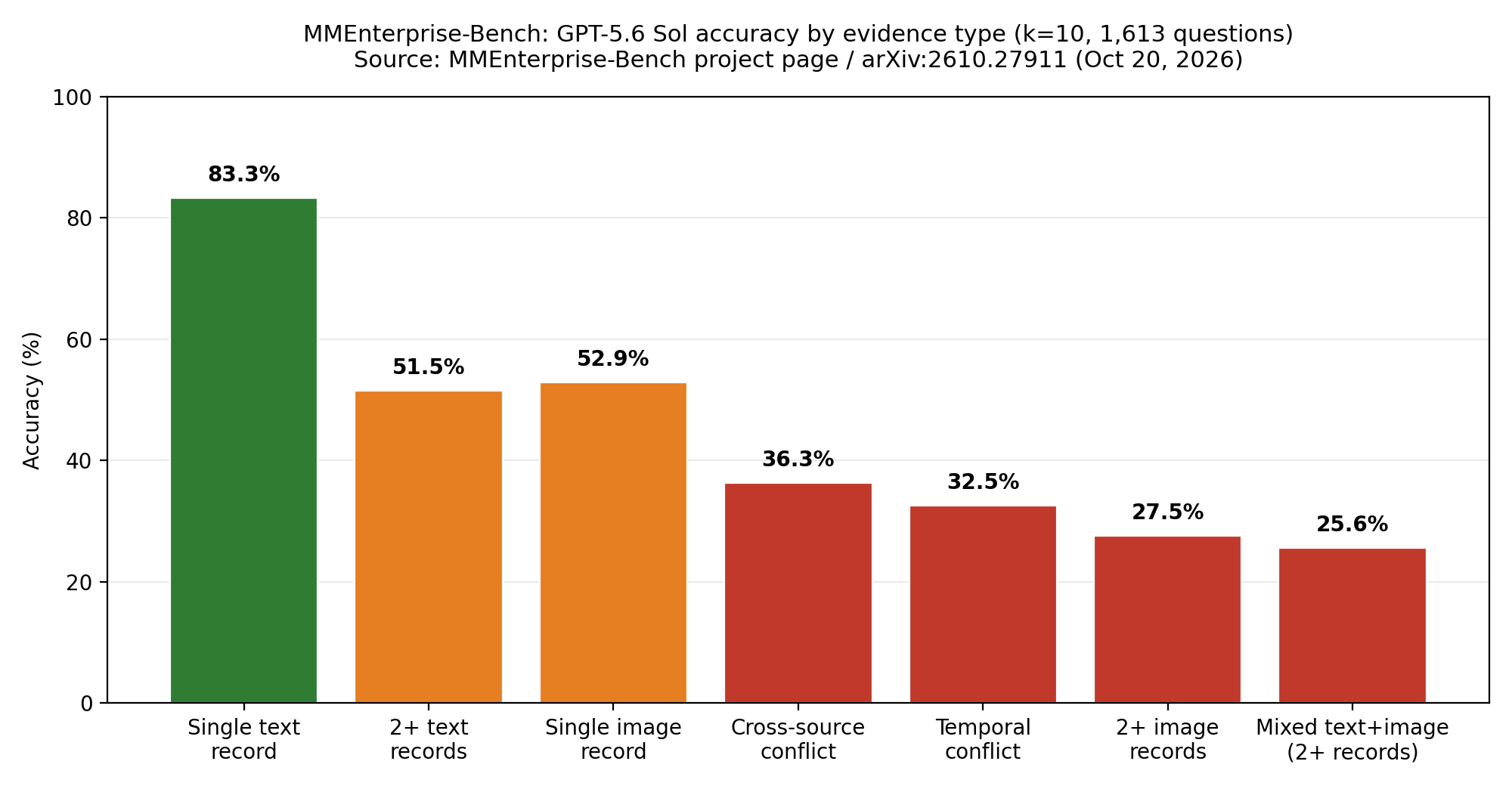
For the strongest model, GPT-5.6 Sol, at the default k=10:
| Evidence shape | Accuracy |
|---|---|
| Single text record | 83.3% |
| 2+ text records | 51.5% |
| Single image record | 52.9% |
| Cross-source conflict | 36.3% |
| Temporal conflict | 32.5% |
| 2+ image records | 27.5% |
| Mixed text + image, 2+ records | 25.6% |
That is a 55.8-point gap between “the answer is in one clean text record” and “the answer spans multiple images” — for the same model, in the same benchmark, on the same day.
Overall, Sol reaches 52.6% at k=10 and 68.0% at k=50. The best open-source model, Qwen3.5-27B, reaches 50.3% at k=50. Nobody is close to ceiling, and the errors concentrate exactly where real workplaces are messiest: Conflict Resolution scores 36.3% (cross-source) and 32.5% (temporal) at k=10, against 67.5% on plain extraction.
More retrieved records do lift the conflict scores — at k=50, Sol reaches 55.2% on cross-source and 56.1% on temporal conflicts — but they remain roughly 20 points below its extraction score at the same k (77.6%). Retrieval narrows the gap; it does not close it.
Recall is not accuracy
The paper’s most transferable finding is about the retrieval lever itself:
- Raising k from 50 to 100 lifts Evidence Recall@k from 57.0% to 64.8% (2B retriever; 41.3% at k=10).
- Yet Qwen3.5-2B’s overall accuracy falls from 25.0% at k=50 to 22.2% at k=100 — more of the right evidence in context, worse answers.
- The larger 8B retriever adds recall (67.3% at k=100 vs. 64.8% for the 2B) but, in the authors’ words, “not consistently accuracy.”
For a frontier model, scaling k does help: Sol goes 52.6% → 68.0% → 75.9% across k=10, 50, 100 with the 2B retriever. So the honest statement is not “retrieval doesn’t matter.” It is: retrieval scaling is model-dependent, and even where it works, conflict resolution stays the lowest slice. If your dashboard only tracks recall, you will keep buying the lever that is easiest to measure.
The unanswerability inversion
One more number worth stealing: on recognising that a question cannot be answered from the records, the overall leader is not the best model. At k=10, Gemini 3.8 Flash scores 87.4% on Unanswerability vs. GPT-5.6 Sol’s 65.5%. The strongest reasoner is more willing to answer a question that has no supported answer. In an enterprise setting — a deadline, a figure, an approval — a confident obsolete or invented value is worse than an abstention.
Caveats, stated plainly
- The projects are simulated: collaborative events were planned by an LLM and realised as synthetic chats, emails, and slides from public seed documents. This is not a measurement of any real company’s deployment or worker outcomes.
- Scoring uses an LLM judge (GPT-5.6 Luna), not human grading of all 1,613 answers.
- Quality control was checked, not assumed: in a blind audit of 100 annotations by three annotators, 71% were rejected by no one and 29% by at least one; none of the 50 LLM-accepted items was rejected by any annotator, and all 29 human-rejected items had also been rejected by the LLM check.
- The headline slices above are at k=10 with the 2B retriever unless stated otherwise. Change k and the absolute numbers move — the ordering of the failure modes does not.
What to do on Monday
- Build a 50-question conflict slice from your own revised documents — 25 cross-source (same fact, different source) and 25 temporal (same fact, revised over time). This is the slice your general QA eval is hiding.
- Apply a 60% gate. If your agent scores below 60% on that slice at your production k, freeze retrieval-budget and retriever-size increases. You do not have a retrieval problem yet; you have a precedence problem.
- Add an explicit version-precedence rule before you add context: latest timestamp wins unless a named source outranks it, and require the answer to cite the record that superseded the old one. Test whether the rule, not the bigger k, moves the conflict slice.
- Track recall and conflict accuracy as two separate lines. If recall rises two evals in a row while conflict accuracy is flat, stop spending on retrieval — that is the MMEnterprise-Bench pattern, reproduced in your own stack.
- Score abstention separately. If your best model answers unanswerable questions more often than a cheaper model does, route low-evidence questions to the model that abstains better, not the one with the higher overall score.
The debatable claim
Most enterprise RAG budgets are allocated backwards: the money goes to finding more evidence, while the failures come from adjudicating between evidence that was already found. Until an agent can show which version it believed and why, a larger context window is just a larger pile of contradictions.
Sources: MMEnterprise-Bench paper and project page (arXiv:2610.27911, released October 20–21, 2026).
Share on
Twitter Facebook LinkedIn☕ Buy me a coffee! 💝
If you found this article helpful, consider buying me a coffee to support my work! 🚀