
Uno: the diffusion adapter that makes the draft model obsolete
Published:
The paper is from September 3. I’m writing about it now because the release went production-shaped this week: open weights, open code, and third-party coverage reporting serving-stack support. That timing matters — an inference paper you can actually deploy is a different object than an inference paper you can only admire.
Paper: arXiv:2609.04010 · Code and checkpoints · from the Institute of Foundation Models (the K2 Horizon lab)
The setup: why the sequential tax still matters
Autoregressive decoding generates one token per step — a hard sequential bottleneck. The field’s two answers have both been compromises:
- Speculative decoding (EAGLE-3 and friends) is lossless, but it needs a separate draft model: train it, align it, version it, keep it in sync with the target, and serve two KV caches. The math is clean; the ops are not.
- Diffusion LLMs generate tokens in parallel natively, but they’re lossy relative to a good AR model — and, crucially, their speedups vanish at large batch sizes (the Uno paper cites Wu et al. 2025, Fu et al. 2026, and the DiffusionGemma team on this). As the authors put it: “Batch-size-one latency captures a narrow operating regime and may overstate speedups that diminish under concurrency.” Agentic workloads batch hard. A speedup that dies at batch 64 is a demo, not infrastructure.
Uno’s bet: keep the AR distribution exactly, and learn to draw multiple tokens from it in parallel.
What Uno actually does
Decouple the parameters into two sets: AR weights trained with the standard next-token objective (frozen), plus lightweight diffusion weights trained to generate token blocks in parallel. The diffusion weights are learned in a “Diffusion Distillation” phase the authors describe as negligible overhead on the training pipeline. A sampler family called Ψ-Spec then draws parallel tokens with AR-verified acceptance — the same rejection-sampling guarantee that makes speculative decoding lossless.
The concrete recipe for the open-weight experiment (UnoQwen, §5.2):
- Base: open Qwen3-8B checkpoint, AR weights frozen
- Per weight matrix: rank-128 LoRA adapter, α=256 → 0.35B trainable parameters (~4.4% of the base)
- 3 epochs / 14.7B tokens on OpenThoughts3-1.2M, block-size curriculum B ∈ {2,4,6,8,12,16}, ~32 hours on 32 H200s
No separate draft model. One architecture, one shared KV cache.
The numbers (paper’s Table 2, Qwen3-8B)
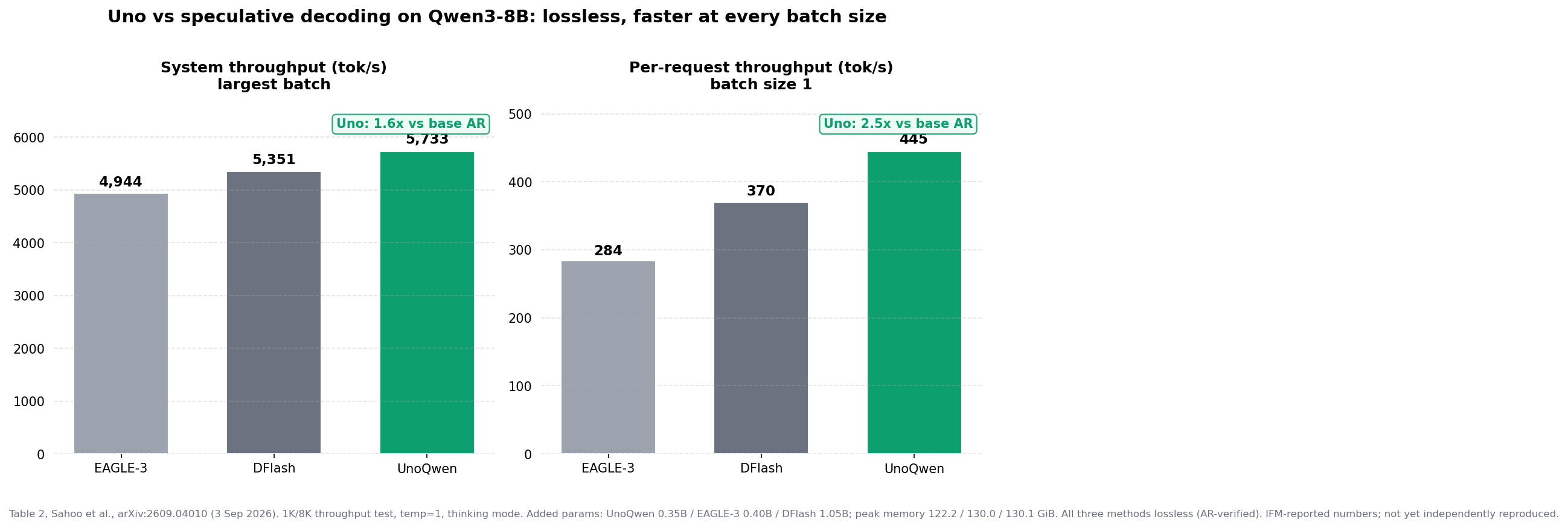
| UnoQwen | EAGLE-3 | DFlash | |
|---|---|---|---|
| System throughput, tok/s (max batch) | 5,733 | 4,944 | 5,351 |
| Per-request throughput, tok/s (batch 1) | 445 | 284 | 370 |
| Speedup vs base AR | 1.6× / 2.5× | — | — |
| Added parameters | 0.35B | 0.40B | 1.05B |
| Peak memory, GiB | 122.2 | 130.0 | 130.1 |
The paper’s headline numbers for the from-scratch 8B model: up to 3× over the base AR model, and up to 2× at the largest batch size the device supports. And on quality, the 8B from-scratch Uno beats the 26B DiffusionGemma and the proprietary Mercury 2 across agentic tool use, coding, and long-context reasoning benchmarks. A model one-third the size winning outright is the kind of result that makes you re-read the methods section.
Also worth noting: DFlash’s drafter is 1.05B parameters — 3× Uno’s adapter — and its training needs context length B·L versus Uno’s constant 2·L. The draft model isn’t just an ops burden; it’s a training-cost burden too.
What’s genuinely good here
Credit where it’s due, because the execution is senior:
- Open paper, open weights, open code. The claim is checkable. That’s the bar from the K2 Horizon release applied to their own follow-up work.
- Evaluated at realistic batch sizes — the paper’s own framing, and Uno holds its lead at the largest batch, where d-LLM speedups die. This is the evaluation discipline the field keeps asking for, practiced by the authors themselves.
- The training story is cheap enough to be real. 0.35B adapter params, 32 H200s for 32 hours, per base model. That’s a rounding error next to a pretraining run — it means a team could plausibly do this to their fine-tuned 8B without a research budget.
The honest caveats
- “Lossless” is the same guarantee speculative decoding already offered. AR-verified rejection sampling preserves the target distribution in both. The paper itself doesn’t even report accuracy for the lossless methods — “any differences arise from sampling randomness and numerical nondeterminism.” The novelty is the mechanism (in-architecture adapter, no draft model), not the guarantee. Anyone selling this as “the first lossless speedup” is misreading it.
- The 2.5×/3× headlines are vs the un-accelerated base AR model. Against the best draft model (DFlash), UnoQwen is +7% on system throughput and +20% per request. That’s a real win, not a regime change. If your team already runs speculative decoding well, this is an upgrade candidate, not an emergency.
- One model class, one scale. Everything above is 8B. The adapter is trained per base model — 14.7B tokens and a thousand H200-hours is cheap for a lab, but it’s not zero, and generalization across model families is unproven.
- No independent reproduction yet at time of writing. These are IFM’s numbers on IFM’s harness. Treat them as the upper bound for your own capacity planning, not the planning number.
What to do Monday morning
- If you run speculative decoding in production on an 8B-class model: spend one sprint benchmarking the Uno adapter recipe against your current draft-model setup — on your traffic mix, at your p50 batch size. Switch only if you clear ≥15% sustained throughput at equal quality. Below that, the retraining and rollout churn isn’t worth a single-digit gain.
- If you’re choosing an acceleration strategy for a new deployment: price the draft model’s total cost first — train, align, version, keep in sync with the target, serve a second KV cache. Uno’s real edge isn’t the 1.6×; it’s deleting that entire line item. Any draft-model-based proposal now has to beat an in-architecture adapter by a wide enough margin to justify its ops surface.
- Capacity-planning rule: haircut any vendor’s max-batch throughput claim by ~25% until you’ve reproduced it on your hardware with your traffic. The paper’s numbers are honest, but they’re still the author’s hardware, the author’s harness, the author’s best config.
The debate
If a 0.35B in-architecture adapter is lossless, shares the KV cache, and beats purpose-built draft models at every batch size — is there any reason left to train a separate draft model, or is speculative decoding’s two-model era just… over?
Share on
Twitter Facebook LinkedIn☕ Buy me a coffee! 💝
If you found this article helpful, consider buying me a coffee to support my work! 🚀