
DeepSeek V4.1-Flash: The Billable Unit Is No Longer the Model — It’s the Cache
Published:
The headline
DeepSeek released V4.1-Flash on September 10: a 552B-parameter mixture-of-experts model with a causal encoder-decoder (CED) architecture, a 1M-token context window, native vision, and MIT-licensed weights on Hugging Face. The vendor benchmark table — every model at maximum reasoning effort — shows DeepSWE v1.1 at 74.2 vs Claude Opus 5’s 74.0 and GPT-5.6 Sol’s 73.0; Terminal-Bench 2.1 at 90.6 vs 89.1 vs 88.8; CyberGym at 88.1; AutomationBench at 54.8. All verified against DeepSeek’s own technical report and model card, not press coverage.
What’s genuinely good
The engineering here is real, and it deserves credit before the critique. The CED design splits the 40-layer transformer into a 20-layer causal encoder and a 20-layer decoder, so the model activates only 8B parameters per token during prefill (input) and 16B during decode (output) — a 552B backbone that reads cheaply and thinks expensively. Compressed Sparse Attention 2 plus FP4 KV caching compresses the global KV footprint to 890 bytes/token — roughly a quarter of V4-Flash’s, a 437× reduction versus V1 — and the SWA Bounded Replay deployment trick cuts the persistent SSD/host-memory cache to roughly one-eighth. Single-token decode FLOPs grow only ~25% when context expands 256× from 4K to 1M tokens. Pretrained from scratch on 45T tokens. For input-heavy agentic loops — a coding agent re-reading the same repository all day — this is exactly the right optimization target, and it’s the rare release where the architecture paper is more interesting than the score table.
Three things the headline hides
1. The 0.2pp “win” is a tie — and the vendor’s own table proves it. DeepSWE v1.1: 74.2 (Flash) vs 74.0 (Opus 5) vs 73.0 (Sol), all at reasoning effort 100. DeepSeek’s own evaluation notes treat scores within 0.3 as equivalent (stated for their base-model comparisons; the principle travels). More damning for the headline: DeepSeek’s own scaffold table shows the same checkpoint scoring anywhere from 65.5 to 74.2 on DeepSWE v1.1 across eight harnesses (Claude Code, Codex, OpenCode, Pi, mini-SWE, and three DeepSeek Harness modes) — an 8.7pp swing from the harness alone, more than forty times the 0.2pp gap to Opus 5. If you want my standing rule updated: on agentic benchmarks, treat any gap under ~9pp as a tie unless the harness is fixed and published.
2. Every headline number runs at reasoning effort 100 — the least economical setting. The technical report’s own curve: raising effort from 25 to 100 lifts DeepSWE v1.1 from 66.0% to 74.2% and Terminal-Bench 2.1 from 82.4% to 90.6%, at roughly 2.5× the output tokens. The 60–80 range already recovers most of the maximum-effort accuracy at under half the token budget, while the final step to 100 makes agent trajectories 1.6–1.8× longer for marginal gains. DeepSeek’s public API exposes presets low=50, high=75, max=100. The leaderboard config is not a production config — copying it into your agent stack burns ~2.5× tokens for single-digit-point gains.
3. The table isn’t uniformly good — read the whole row. Terminal-Bench 3.0: 30.0 vs Opus 5’s 43.3. Terminal-Bench 4.0: 31.2 vs 51.8. ExploitGym: 15.3 vs GPT-5.6 Sol’s 33.7. GPQA Diamond: 90.9 vs Sol’s 94.1. This model wins on SWE-shaped work and loses badly on terminal-ops-shaped work. That’s not a flaw — it’s the point: buy for your workload shape, not the headline cell. (Credit to DeepSeek for publishing the full row, including the losses. More vendors should.)
The real story: the billable unit is the cache
Off-peak, DeepSeek prices cached input at $0.003 per million tokens (cache miss $0.15, output $0.60; peak hours — Monday–Friday 01:00–04:00 and 06:00–10:00 UTC — are exactly double). Now do the builder math: an agent that keeps a 500K-token reusable prefix (repo, tool definitions, system instructions) and hits cache across 100 requests burns 50M cached input tokens. That’s $0.15 on V4.1-Flash off-peak versus $15 on Kimi K3 ($0.30/M cached), $20 on GPT-5.6 Sol ($0.40/M), $25 on Claude Opus 5 ($0.50/M). A 100–166× spread on the exact token class that dominates long-running agent workloads — for scores that, on several benchmarks, are within noise of each other.
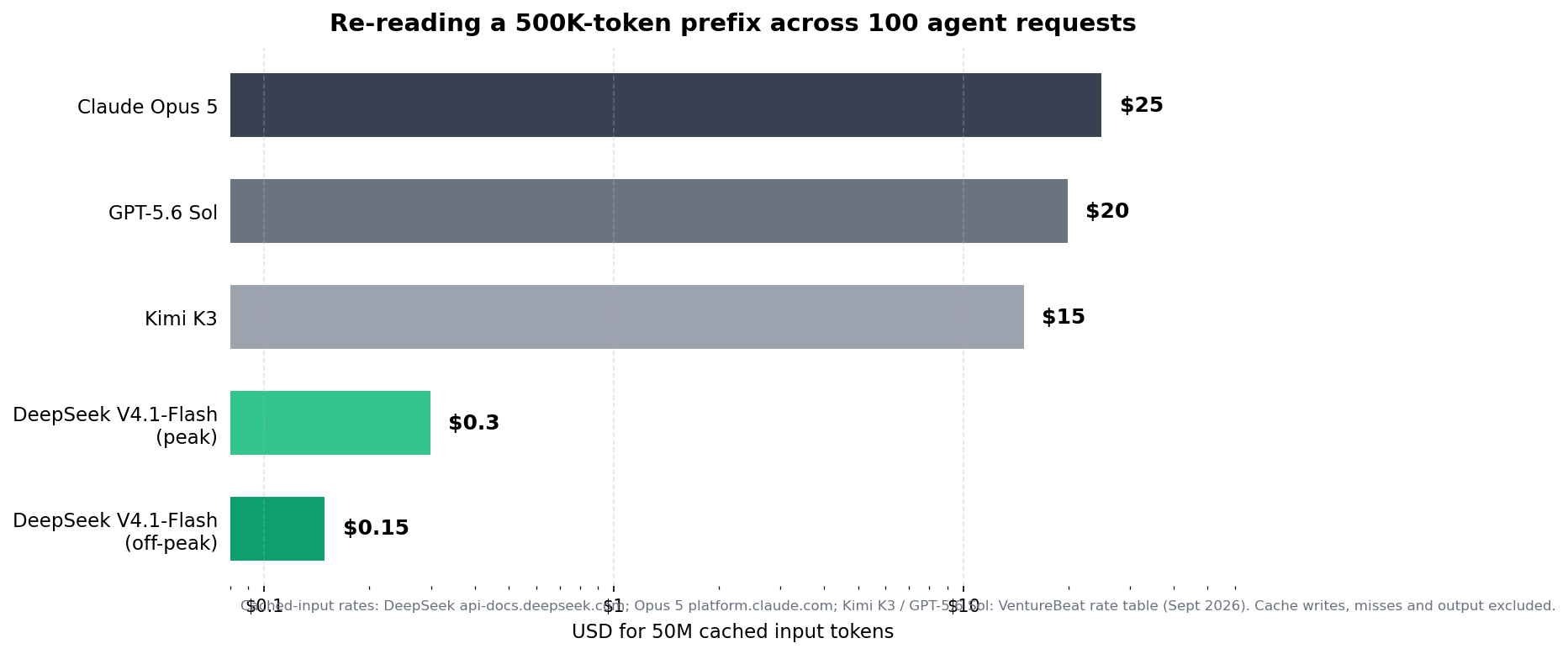
The instrumentation hasn’t caught up to the economics. VentureBeat’s July 2026 survey of 170 enterprises found only 47% rigorously track AI compute cost and ROI, and just 31% named cost-per-million-tokens a primary infrastructure metric. If you’re in the 53% that doesn’t track it, you’re negotiating blind: comparing models on uncached input price alone can obscure the fastest-growing component of your agent bill.
Monday-morning checklist
- Log cache-hit ratio per agent task this week — cached vs uncached input tokens, and cost per completed task. If >80% of your input tokens are cache reads, model choice is a second-order decision. Move schedulable batch agent jobs outside DeepSeek’s peak window (Mon–Fri 01:00–04:00 & 06:00–10:00 UTC; everything else is off-peak).
- Route reasoning effort by task tier: low/non-thinking for lint and routine edits, high (75) for feature work, max (100) only for genuinely hard debugging. Never copy leaderboard settings into production.
- Discount vendor agentic-benchmark gaps under ~9pp to ties unless the harness is fixed and published — then re-run on your own traces before any migration. DeepSeek just handed us the receipts for why.
- Pin model identifiers and re-run golden evals after any vendor-side routing change. DeepSeek announced V4-Pro API traffic would route to Flash starting September 14 — then walked it back after developer pushback and kept V4 Pro live with unchanged billing. Silent model swaps are a real dependency risk, and this week proved the community can push back on them.
The debate
If a model with 100× lower cached-token pricing is within noise of the frontier on your agentic benchmarks, what exactly are you paying frontier prices for? My read: the frontier is becoming a latency-and-output-quality product for the hard 5% of tasks, and a cache-management problem for everything else. Where does the frontier premium still earn its keep on input-heavy workloads — terminal-ops, security, something I’m missing?
Sources
- DeepSeek-V4.1-Flash model card and evaluation tables: huggingface.co/deepseek-ai/DeepSeek-V4.1-Flash
- Technical report (PDF, §5.3.2–5.3.4): huggingface.co/deepseek-ai/DeepSeek-V4.1-Flash/resolve/main/DeepSeek_V41_Tech_Report.pdf
- Official pricing (Flash: $0.003/M cached input off-peak; peak = 2×): api-docs.deepseek.com/quick_start/pricing
- Claude Opus 5 prompt-caching pricing ($0.50/M cache hits): platform.claude.com/docs/en/about-claude/pricing
- Kimi K3 / GPT-5.6 Sol cached rates ($0.30/M, $0.40/M): VentureBeat rate table, Sept 2026
- V4-Pro routing announcement and walk-back: TechNode, Sept 10 + DeepSeek API docs footnote 2
- Enterprise AI cost-tracking survey: VentureBeat Pulse Research, July 2026 (n=170)
Share on
Twitter Facebook LinkedIn☕ Buy me a coffee! 💝
If you found this article helpful, consider buying me a coffee to support my work! 🚀