
Coding-Agent Spend Is Payroll, Not SaaS
Published:
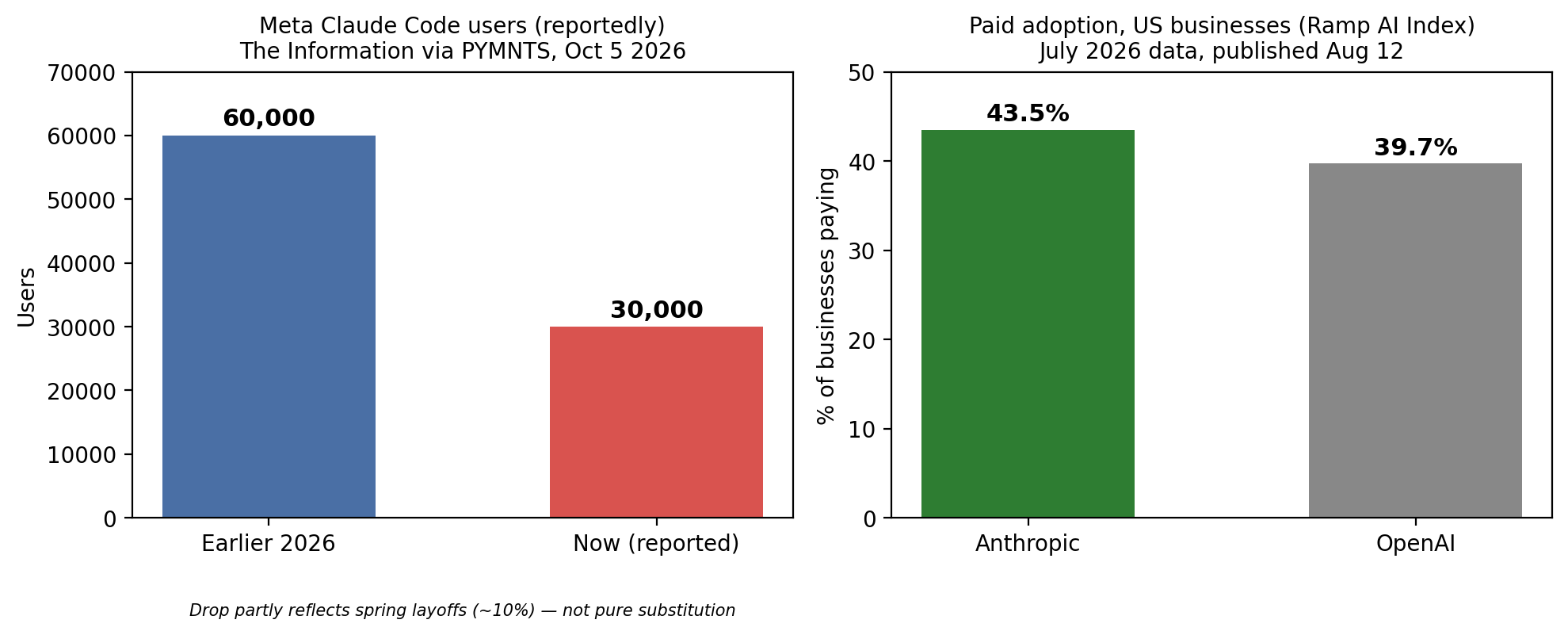
Anthropic still leads paid enterprise adoption. That is the starting point, not the footnote.
In the Ramp AI Index for July 2026 (published August 12), 43.5% of U.S. businesses tracked by Ramp paid for Anthropic, versus 39.7% for OpenAI. Ramp is the source only for that figure, and it is July data — not a live share.
Against that lead, two reported moves this week look dramatic. They are better read as economics.
What was reported
PYMNTS on October 5, 2026, relaying reporting by The Information, said:
- Reportedly, Meta’s employees using Claude Code fell from about 60,000 earlier this year to about 30,000, as Meta pushed its own Muse Code and MetaCode tools. Meta did not comment in The Information’s reporting and did not immediately reply to PYMNTS.
- Reportedly, Microsoft was on track to spend about $1 billion this year on internal use of Anthropic technology and cut that projection by one-third. A Microsoft spokesperson confirmed steering staff to GitHub Copilot, while noting engineers may still choose other models.
Two caveats matter. First, this is reported, not audited — The Information’s original is paywalled and PYMNTS is the relay level used here. Second, secondary aggregation of that reporting notes part of Meta’s drop reportedly came from spring layoffs of about 10%, not pure tool substitution, and puts MetaCode at 30,000+ internal users and Muse Code at 6,000+. Treat those last figures as secondhand. Even with the caveat, the direction is clear: part substitution, part headcount, part cost control.
I am not using two figures circulating in aggregation sites — a $105M / 28-day spend figure and a $100k-to-$10k per-employee cap — because they do not appear in the PYMNTS original.
Why this is payroll economics
At a few hundred engineers, a coding agent is a SaaS line item. At tens of thousands of engineers, it behaves like payroll:
- Cost scales with headcount and usage intensity, not seats alone.
- Usage is hard to forecast. A WSJ-reported study of about 400 businesses found only 11% could accurately predict AI spending. That figure is from the WSJ-reported study — not from Ramp.
- Cheaper per token does not mean cheaper per task. In testing by Stanford, CMU, UC Berkeley and Microsoft Research on 6,800+ tasks, reported in the same WSJ piece via PYMNTS, cheaper models ended up more expensive than pricier ones in 32% of scenarios, because they took extra steps.
That last point cuts both ways. It is praise-first evidence that the expensive frontier tool is not automatically wasteful — and it is also why a finance team cannot approve spend on token price alone.
So when a hyperscaler builds an internal tool that is good enough for most pull requests, substitution is a cost-control move. It is not, by itself, a quality verdict on the external tool it replaces.
What to do on Monday
If your external coding-agent bill tops $200 per engineer per month, A/B the internal (or cheaper) tool on 20 real PRs before the next renewal. Measure cost per merged PR — tokens, retries, and review time — not cost per token. Keep the frontier tool for the PRs where the cheap tool fails or loops.
That threshold will be wrong for some teams. The discipline is the point: one workload, one head-to-head, one renewal decision backed by your own PRs instead of a vendor benchmark.
The open question
When an internal tool reaches 80% of the best external one, do you mandate it — or keep paying for the last 20%?
My lean: mandate the default, keep a paid escape hatch for hard tasks. Defaults control cost; escape hatches protect quality where it actually shows up in merged code.
Sources
- PYMNTS, Oct 5 2026, on Microsoft and Meta steering staff from Claude to in-house tools: https://www.pymnts.com/news/artificial-intelligence/2026/microsoft-meta-steer-staff-from-anthropic-claude-in-house-ai/
- PYMNTS, Oct 5 2026, relaying WSJ on forecasting difficulty and the 6,800+ task study: https://www.pymnts.com/news/artificial-intelligence/2026/businesses-finding-it-harder-to-predict-ai-spending/
- WSJ, Oct 5 2026, on AI spending forecasting (11% of nearly 400 businesses; 32% of 6,800+ tasks): https://www.wsj.com/tech/personal-tech/ai-token-spending-businesses-431ee94a
- Ramp AI Index July 2026 data (43.5% Anthropic, 39.7% OpenAI), published Aug 12, as reported Aug 20: https://www.unite.ai/openai-closes-on-anthropic-in-ramps-business-spending-data/
Share on
Twitter Facebook LinkedIn☕ Buy me a coffee! 💝
If you found this article helpful, consider buying me a coffee to support my work! 🚀