
🥽 VR, AR & AI Glasses: The 2026 Market Guide (Meta VR Glasses, Steam Frame, Snap SPECS & China’s AI Glasses Wave)
Published:
September 2026 was the busiest month for headsets in years. Valve launched the Steam Frame on September 14, and nine days later Meta’s Connect keynote unveiled the Meta VR Glasses ($1,299.99, spring 2027), the camera-free Ray-Ban Meta Audio ($349), and Gen 3 Ray-Bans. This post is the comparison I wish existed: every product that matters right now, what each one is actually for, and what to buy for gaming vs. movies vs. all-day wear — with real data charts at the end.
One clarification before we start, because the industry deliberately blurs these lines. There are four different products hiding under the word “glasses”:
- VR / MR headsets — Quest 3, Vision Pro, PSVR2. Big, immersive, sealed off from the world. Best for gaming and cinema.
- Display glasses — XREAL One Pro, VITURE Pro. Ordinary-looking glasses with a giant virtual screen. Best as a portable monitor.
- True AR glasses — Snap SPECS, RayNeo X3 Pro. Digital objects anchored in your real view. Still mostly developer-grade.
- Camera / audio AI glasses — Ray-Ban Meta, Xiaomi AI Glasses. Sunglasses with a camera, speakers and an AI assistant. Best for everyday life.
They don’t compete with each other nearly as much as the marketing suggests. Buy the category first, then the product.
A note on prices: Every price below was checked on September 24, 2026 — but prices in this industry move constantly (flash sales, memory-cost hikes, regional taxes), so treat them as a snapshot, not a quote. Check the product page before you buy.
The two launches that changed everything
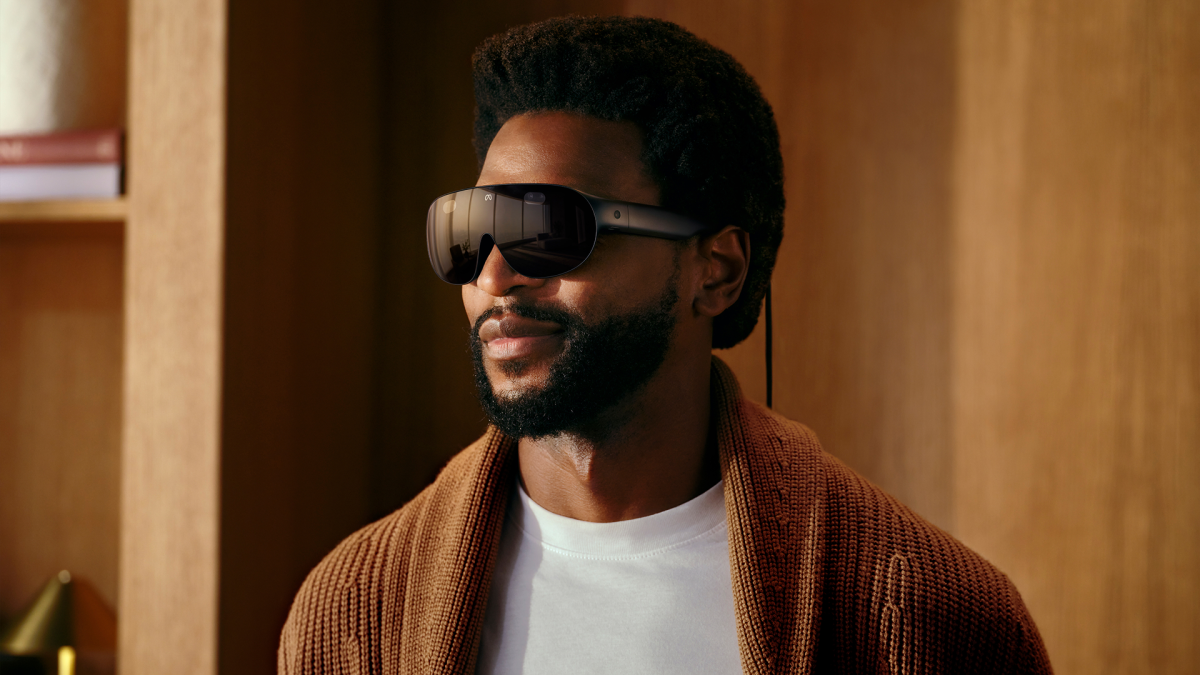 Meta VR Glasses — image: Meta (about.fb.com)
Meta VR Glasses (announced Sept 23, 2026; on sale spring 2027, $1,299.99) is Meta’s biggest hardware bet since the Quest. The trick is the split architecture: the glasses themselves hold only displays and sensors at ~100g — five times lighter than a Quest 3 — while compute, battery and storage live in a pocket puck (~300g) connected by an optical cable. Specs: 5K micro-OLED “Infinite Display,” 37 pixels per degree, custom pancake lenses, Snapdragon Reality Elite, up to 3 hours of media playback with 45W fast charging, Dolby Vision + Dolby Atmos built into the frames, eye and hand tracking (controllers sold separately).
The pitch is entertainment, not the metaverse. It’s the first IMAX Enhanced-certified VR device; Disney+ streams select Marvel titles in 3D starting this November (before the headset even ships); a Disney Immersive Cinema app by ILM brings “VR Enhanced” versions of Infinity War and A New Hope; Peacock, HBO Max and Paramount+ are offering 3D catalogs for the first time; James Cameron’s Lightstorm Vision brings first-time-in-3D blockbusters in 2027; and Meta promises 100+ immersive live sports events per year (ESPN, MLB, NBC Sports, TNT, UFC) in 8K 180°. Gaming: the full Quest catalog, 75+ games playable with hand gestures at launch (including a hand-tracked Beat Saber: Flux), plus Xbox Cloud Gaming. Hologram Calling (Codec Avatars, from WhatsApp to Zoom) rounds it out. Official announcement: about.fb.com.
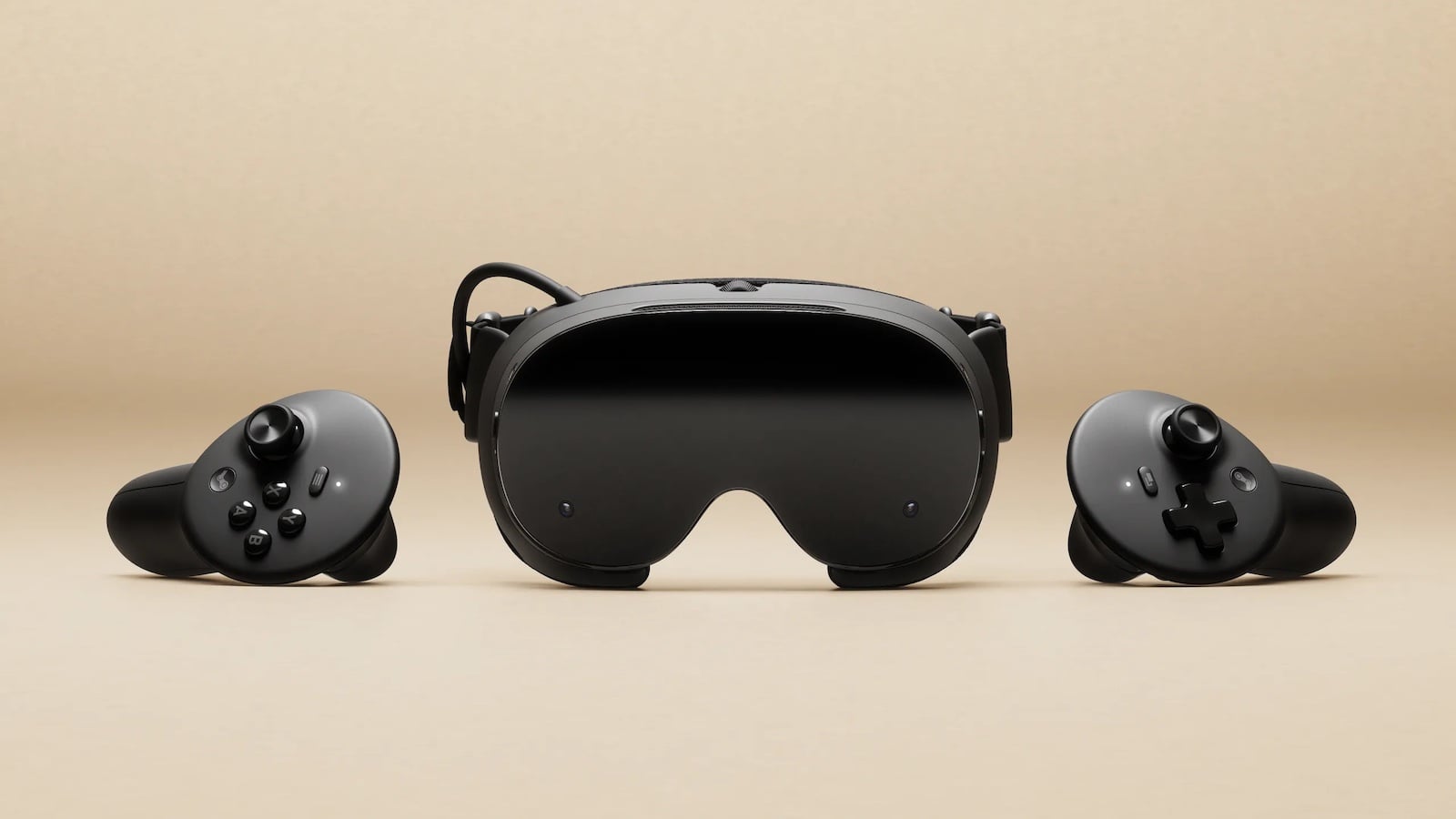 Valve Steam Frame — press render
Valve Steam Frame (launched Sept 14, 2026; $1,059 256GB / $1,299 1TB) is the headset PC gamers spent a decade waiting for. Snapdragon 8 Gen 3, 2160×2160 per-eye LCD pancake lenses, up to 120Hz (144Hz experimental), 440g, eye tracking, and a bundled 6GHz Wi-Fi 6E dongle for wireless PCVR streaming — plus standalone SteamOS with Half-Life: Alyx included. Valve’s Lepton compatibility layer runs Quest/Android-built games natively (~40% of the launch library), and in a twist, some new SteamVR store games are Frame-only — they won’t run on PC-connected headsets. Early reviews call it the best gaming VR headset you can buy. Catch: it sold via a reservation lottery (closed Sept 17), and the 45W charger is a $29 extra.
Note the price collision: Meta VR Glasses ($1,299.99) vs. Steam Frame 1TB ($1,299). Same money, opposite philosophies — Meta bets on movies and lightness, Valve bets on your Steam library.
VR / MR headsets: the full comparison
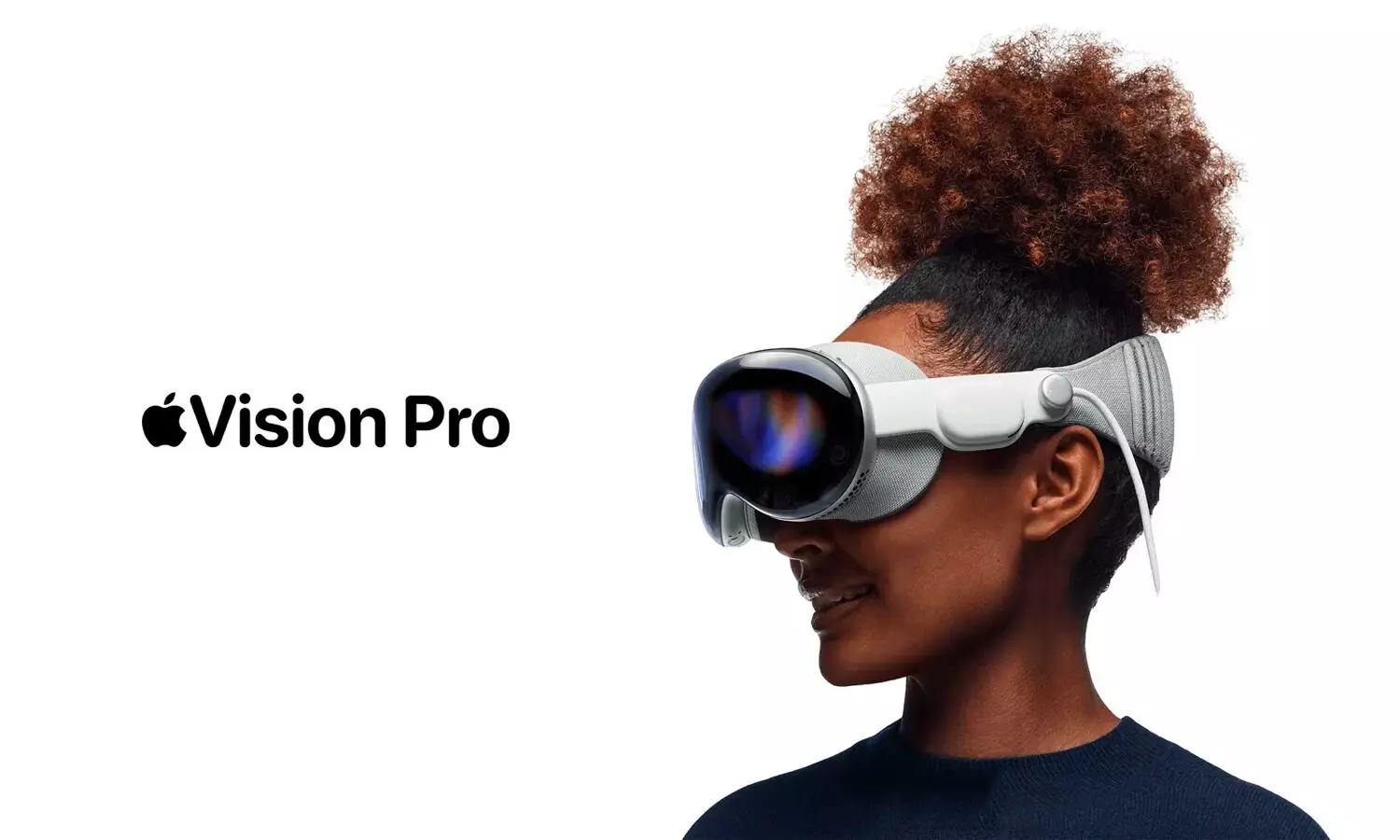 Apple Vision Pro — product shot
- Meta Quest 3 — $599.99 (512GB; the 128GB model was discontinued after an April 2026 price hike blamed on memory costs). 2064×2208 per-eye LCD pancake, ~25 PPD, XR2 Gen 2, 515g. Still the default all-rounder: standalone gaming plus good-enough color mixed reality, and the largest app library.
- Meta Quest 3S — $349.99 (128GB) / $449.99 (256GB). Quest 2-era Fresnel lenses, 1832×1920, 96° FOV, same XR2 Gen 2 chip. The cheapest way into real VR — and there’s a Quest 3S Xbox Edition ($399) bundling an Xbox controller and 3 months of Game Pass Ultimate.
- Apple Vision Pro — now $3,699 (256GB; Apple raised it from $3,499 in June 2026 in a memory-crisis price bump). The expected M4 refresh never happened — Apple skipped straight to M5 (Oct 2025). Dual 4K micro-OLED, ~34 PPD, up to 100Hz, 600–650g plus a 353g external battery. Eye + hand tracking, no controllers, Optic ID. It’s the best virtual cinema money can buy and the most polished spatial computer — at a price and weight that keep it a niche device. A cheaper “Vision Air” is rumored for 2027, unconfirmed.
- Sony PSVR2 — $399.99 (permanently cut from $549.99 in March 2025). 2000×2040 per-eye OLED HDR, 90/120Hz, ~560g, eye tracking, and the excellent Sense controllers with haptics and adaptive triggers. If you own a PS5, this is still the best value in VR gaming. A $59.99 official PC adapter opens up SteamVR on Windows — though you lose HDR, eye tracking, headset haptics and adaptive triggers in the process. Availability heads-up (Sept 2026): PlayStation Direct US lists it as “Currently Unavailable” — new units at $399.99 are hard to find in the US right now.
- Samsung Galaxy XR (ex-Project Moohan) — $1,799.99. The first Android XR device (launched Oct 2025, US/Korea). 3552×3840 per-eye micro-OLED, 109° FOV, Snapdragon XR2+ Gen 2, Gemini AI, 545g with an external pocket battery (~2–2.5h). Motion controllers are a $249.99 add-on — none in the box. The direct Vision Pro competitor for the Android world, and it supports PCVR streaming.
- Pico 4 Ultra — $599. 2160×2160 per-eye AMOLED, 90Hz, XR2 Gen 2, 586g, 12GB RAM (vs. Quest 3’s 8GB), Wi-Fi 7, ringless controllers with haptics. Strong standalone rival to the Quest 3 where it’s sold. (Pico 5 was reportedly canceled; the 2026 project is the rumored “Project Swan” with custom ~40-PPD micro-OLED.)
- HTC Vive Focus Vision — $999. 2448×2448 per-eye LCD, 120° FOV, built-in eye tracking, DisplayPort wired PCVR, hot-swap batteries, 615g. An enterprise/training play that also works as a PCVR headset — but the older XR2 Gen 1 chip at this price is a tough sell for consumers.
- Pimax Crystal Super — $1,599 (on sale; $1,799 list). 3840×3840 per-eye QLED + MiniLED — 57 PPD, the highest pixel density of any consumer headset — trading resolution against FOV in two variants (106° or 127°). PCVR-only, tethered. This is the flight-sim and racing-sim enthusiast’s headset, full stop.
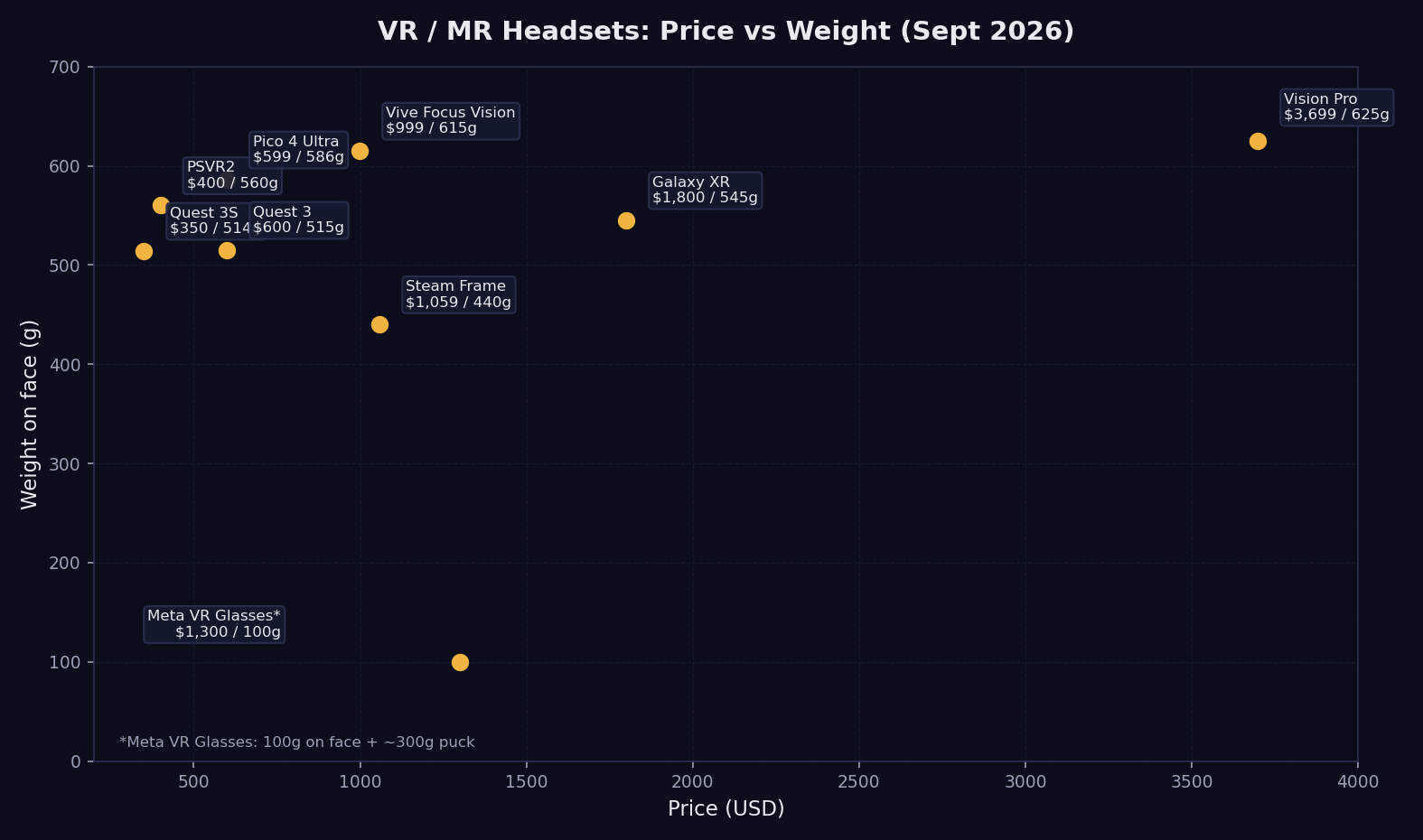 Price vs. weight across the VR/MR headset market. Meta VR Glasses is the outlier: 100g on the face because the computer lives in your pocket.
Gaming: which headset for which player
| If you are… | Buy | Why |
|---|---|---|
| A PC gamer with a Steam library | Valve Steam Frame ($1,059) | Wireless PCVR + standalone SteamOS; Alyx included; Frame-only exclusives now exist |
| A PS5 owner | PSVR2 ($400) | Native PS5 VR games; cheapest entry with the best controllers; optional SteamVR via adapter |
| A standalone gamer, no PC/console | Quest 3 ($600) / 3S ($350) | Biggest library; Quest Link/Air Link/Steam Link VR also open the PC door later |
| A flight/racing sim nerd | Pimax Crystal Super ($1,599) | 57 PPD — nothing else touches it for instrument panels and distant detail |
| An Xbox Game Pass subscriber | Quest 3S Xbox Edition ($399) or Meta VR Glasses | Native Xbox Cloud Gaming app; Horizon+ subscribers get 10 hrs/month incl. gamepad emulation via Touch controllers |
| An Apple-ecosystem gamer | Vision Pro ($3,699) + PSVR2 Sense controllers ($250/pair) | visionOS 26 added 6DoF controller support; first spatial games (Ping Pong Club, Pickle Pro) are here — but there’s still no native SteamVR (Valve’s Steam Link app is 2D-only) |
The honest summary: Steam Frame vs. Quest 3 is now the gaming decision. Frame wins on raw PC gaming and weight (440g vs. 515g); Quest wins on price, library size, and the fact you can actually buy one today.
Movie watching: the sleeper battleground
This is where 2026 got interesting. Headsets are becoming the best personal cinemas ever made — a 200-inch screen on a plane, in silence, with nobody’s head in your way.
| Device | IMAX Enhanced | Dolby Vision | Disney+ 3D | Netflix | Notes |
|---|---|---|---|---|---|
| Meta VR Glasses | ✅ first certified VR device | ✅ + Dolby Atmos | ✅ from Nov (select markets) | — | Disney Immersive Cinema (ILM); Cameron 3D films 2027; 100+ immersive sports/yr; Prime Video, YouTube, HBO Max, Peacock, Paramount+, Plex, Crunchyroll |
| Apple Vision Pro | — | ✅ | ✅ select films | Safari only (no native app) | Strongest 3D library: 150+ titles in Apple TV store; 8K 180° Apple Immersive Video |
| Quest 3 / 3S | — | Select titles (4K HDR streaming) | 2D only | Browser only, up to 1080p (native app discontinued) | Bigscreen virtual theater; weakest premium-video story |
| Galaxy XR | unconfirmed | unconfirmed | — | — | VR theater + native VR games |
| Snap SPECS | — (not a cinema headset) | — | — | — | AR overlay only: virtual 115” screen ~10 ft for YouTube/HBO Max |
Three takeaways:
- Meta VR Glasses is the first headset designed around movies first, games second. IMAX Enhanced certification + Disney+ 3D + 100 live sports a year is a lineup no headset has ever had. The catch: it ships spring 2027, and Disney+ 3D starts this November on Horizon OS devices — so Quest owners get a preview before the glasses exist.
- Vision Pro still has the deepest 3D film library today, and Apple Immersive Video (8K 180°) remains the most impressive thing you can watch in any headset. But at $3,699 and 600g+, it’s a cinema you wear like a punishment.
- Netflix is anti-headset on every platform — it killed its Quest VR app and opted out of visionOS entirely. If Netflix-on-a-virtual-screen is your dream, every headset disappoints equally.
For frequent flyers, there’s also a lighter option than any headset: display glasses (next section) — a 150–200” screen at 80g, no sealed box on your face, no battery anxiety about your seatmate staring.
Display glasses: a giant screen in normal glasses
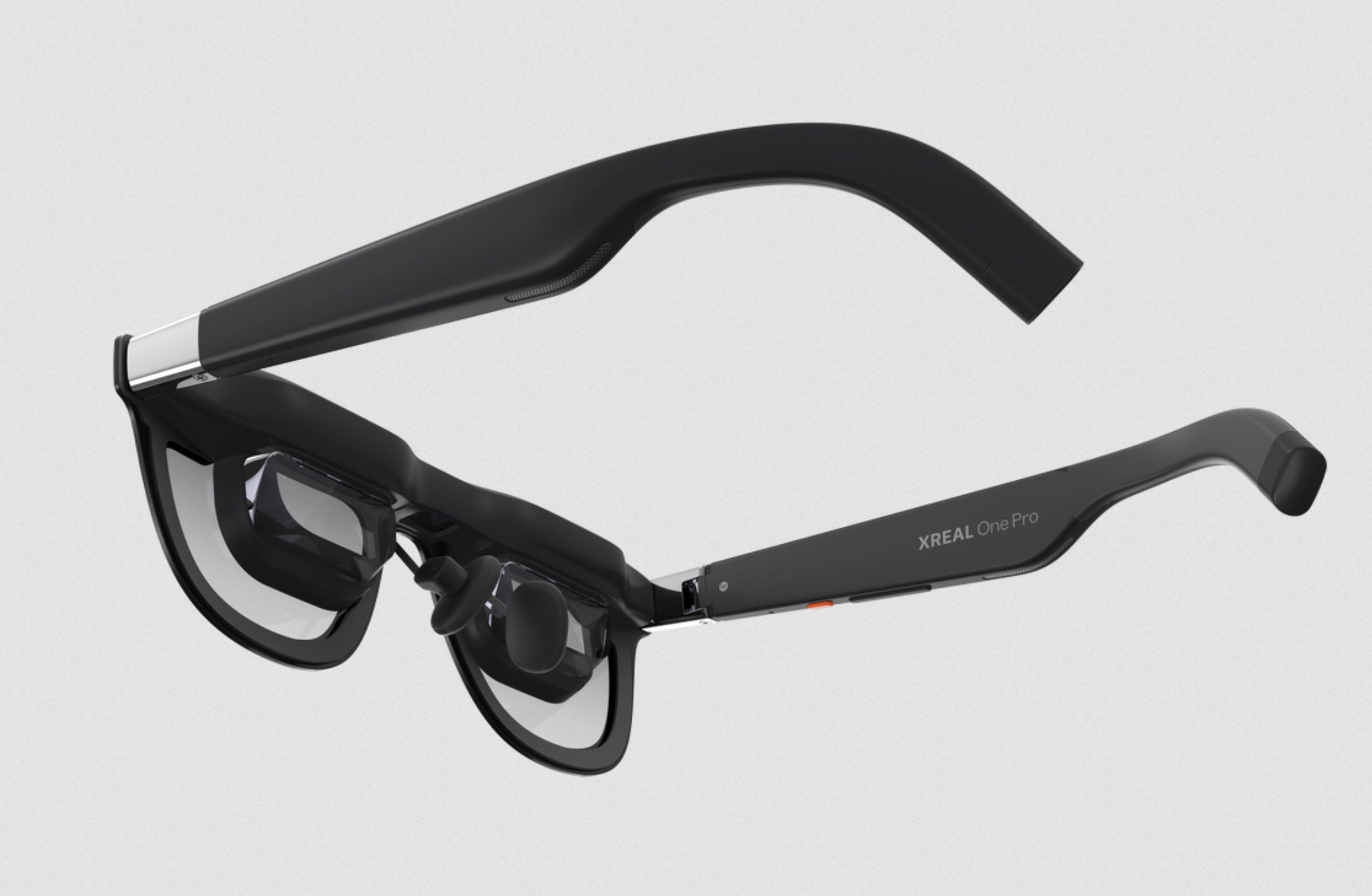 XREAL One Pro — press photo
No cameras, no AI, no spatial computing — just a huge private monitor you wear. Plug into a laptop, phone, Steam Deck or Switch over USB-C and get a 147–201” screen anywhere. This is the most practical category in the whole post, and the one I’d recommend to the most people.
- XREAL One Pro — $549 (was $649). The benchmark: Sony 0.55” micro-OLED, 57° FOV (171” screen at 4m), 87g, 1080p 120Hz, electrochromic dimming, Bose audio, X1 chip, 3DoF (6DoF with a $99 add-on). XREAL One — $399: 50° FOV (147”), 82g, same 1080p/120Hz. There’s also a budget X by Xreal a01 at $299 (62g).
- VITURE Pro XR — $459 (was $549). 46° FOV (135”), 77g, 4,000-nit peak brightness, Harman audio, electrochromic dimming — and the killer feature for glasses wearers: built-in myopia adjustment dials (0 to −5.0D), no prescription inserts needed.
- RayNeo Air 3s — $269 (€299). The value pick: 46° FOV (201” screen), 76g, 1080p 120Hz, quad speakers with Whisper Mode 2.0. A 3s Pro ($299) adds an AI assistant and 12MP camera (currently on sale at $279).
- Meizu StarV View — ¥2,799 (~$399). Sony micro-OLED, 1080p per eye at 120Hz, 51 PPD, 74g, 188” screen at 6m, myopia adjustment to 600°. Works with phones, drones, Switch, PS5 and Steam Deck over USB-C. China-first, expanding to 30+ countries.
If you watch movies on planes or want a private monitor in a café: XREAL One Pro for the biggest screen, VITURE Pro XR if you wear glasses, RayNeo Air 3s if you’re price-sensitive.
True AR: the future, still in beta
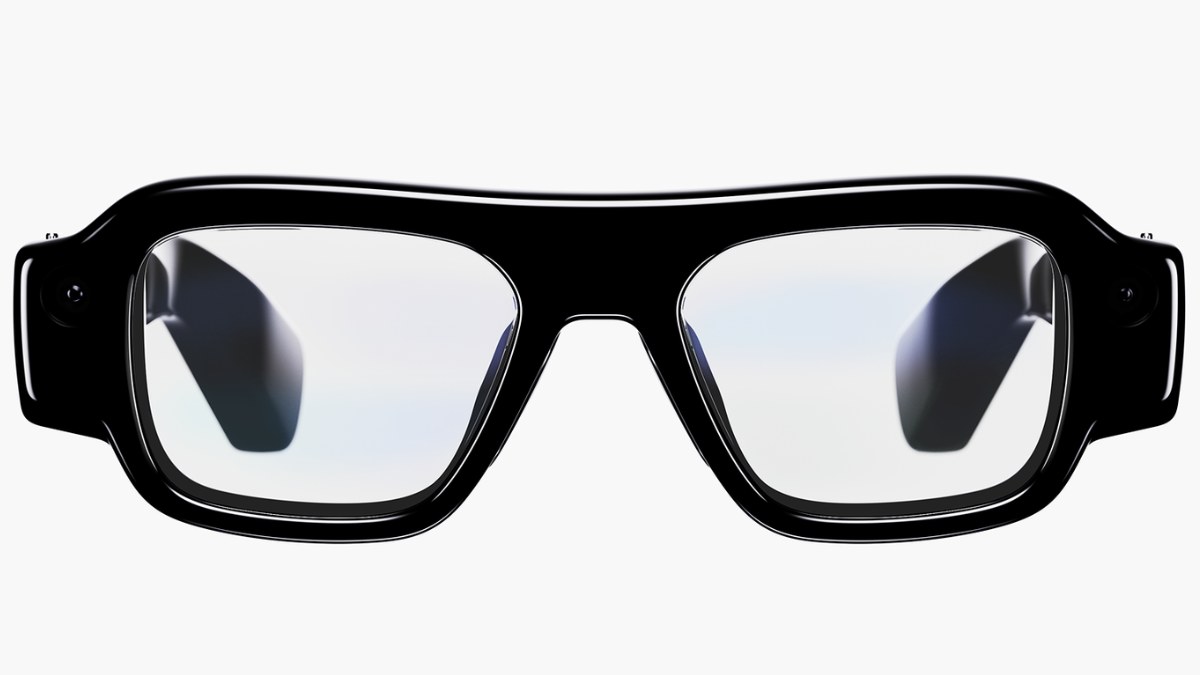 Snap SPECS — launch press photo
This is the category every sci-fi movie promised: digital content anchored in your real world. It’s also the least ready.
- Snap SPECS — $2,195. Pre-order now, ships before end of 2026 (US, UK, France). Fully standalone (dual Snapdragon), 51° FOV, ~132–136g, ~4h mixed use with a charging case extending total use to ~20h. Streams YouTube and HBO Max on a virtual 115” screen ~10 feet away; there’s even a Harry Potter/HBO Max tie-in at Christmas. Developer-first and priced like it — this is a bet on the AR future, not a finished consumer product.
- RayNeo X3 Pro — $1,299. The most capable true-AR glasses you can actually buy: binocular full-color micro-LED waveguides (640×480, up to 6,000 nits peak — readable in sunlight), 30° FOV, 76g, Snapdragon AR1 Gen 1, 12MP + spatial camera, 6DoF, Gemini AI, live translation and navigation. Reviews flag short battery life; it recharges in ~38 minutes.
- INMO Air3 — $1,099. Fully standalone (Snapdragon XR 8-core, 8GB/128GB), binocular full-color 1D waveguide, 1080p, 36° FOV (150” screen), 16MP camera, ~7h battery. A Kickstarter success story now selling globally.
- Google Android XR glasses — coming in three tiers: audio-only frames first (Warby Parker, Gentle Monster, Kering Eyewear), display models later, plus the Xreal-built Project Aura (70° FOV, tethered to a Snapdragon XR2 Gen 2 Plus puck). Gemini AI, navigation, live translation. Target: fall 2026. Not shipping yet.
- Ray-Ban Meta Display — $799. The bridge product: normal-looking Ray-Bans with a single-eye 600×600 display, 12MP camera, ~6h battery, and a neural wristband for gesture control, at 69g. Now rolling out to Canada, the UK, France, Italy and Germany. Not full AR — but the most wearable display Meta has shipped.
Honest assessment: if you want AR today, RayNeo X3 Pro is the buy. If you want the platform bet, it’s Snap SPECS or waiting for Google. Everything else is a demo wearing a price tag.
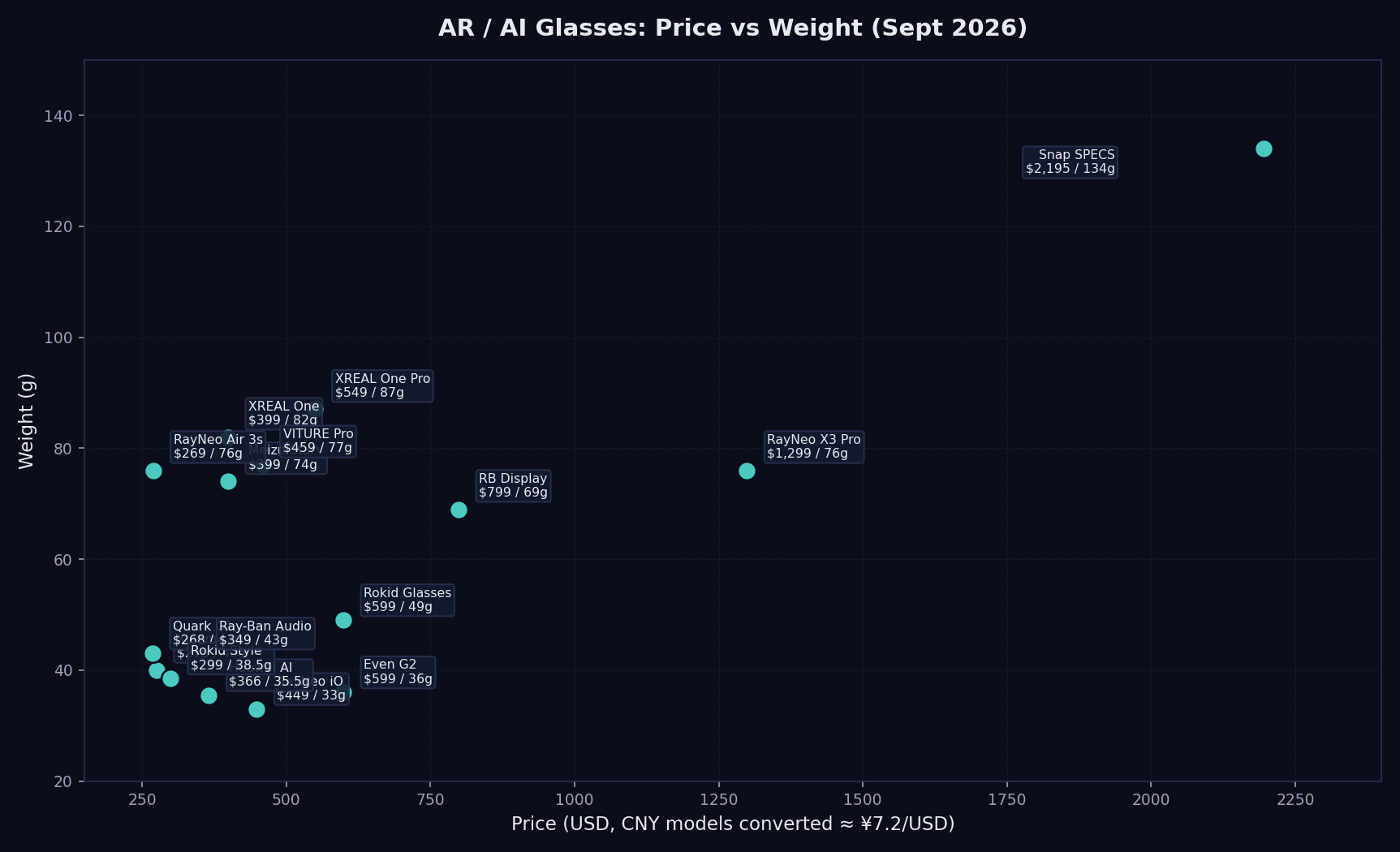 Price vs. weight across the AR/AI glasses market. The cluster at the bottom-left is the real story: capable AI glasses now weigh 33–50g — less than ordinary sunglasses.
AI glasses for everyday life: the camera question
 Ray-Ban Meta Audio — image: Meta (about.fb.com)
This is the category that actually sells in volume — because they’re just… glasses.
- Ray-Ban Meta Audio — $349, ships Oct 13. Meta’s first camera-free glasses: 43g, up to 12 hours per charge plus 48h from the charging case, Clubmaster and Burbank styles in 23 color/lens combinations. Music, calls (a six-mic-grade voice pickup that beats earbuds), and hands-free Meta AI — everything except “what am I looking at.” The privacy pitch is the product: no camera, no LED, no social friction. For people who wanted the Ray-Ban Meta experience without filming strangers, this is it.
- Ray-Ban Meta Gen 3 — $449, available now. Keeps the 12MP camera with 3K video, adds a 6-microphone array (90% noise reduction), an hour more battery (~9h total), a customizable action button, and new Aviator/Zena/Wayfarer styles. Later this year these become the first consumer devices to capture Dolby Atmos 360° spatial audio video.
- Even Realities G2 — $599. The privacy-maximalist pick: no camera, no speakers (audio via mics only), 36g, binocular green micro-LED HUD for translations and a teleprompter, 2-day battery, IP67. An optional $249 R1 ring adds health tracking (HR/HRV/SpO2/sleep).
- Rokid Glasses — $599. The translator’s pick: dual monochrome micro-LED waveguide display, 49g, 12MP camera, GPT-5 + DeepSeek AI, 89-language translation, teleprompter, navigation. Launched July 2026.
- Rokid Style — $299. Audio-only AI glasses: 38.5g, 12MP camera, 12h battery, ChatGPT + DeepSeek, prescription-ready. On sale globally since January.
- RayNeo iO — $449 (MSRP $499). Camera-free like the G2 but with a binocular green micro-LED display (23.5°), 33g — the lightest display glasses on this list — with 55-language dialogue translation and live captions.
China’s AI glasses wave
 Xiaomi AI Glasses — product photo
Here’s the part of the market Western coverage under-reports: China shipped an entire generation of AI glasses in 2026, at prices that make Western products look indulgent — and almost all of them are China-only.
- Xiaomi AI Glasses — ¥1,999 (~$275); electrochromic versions ¥2,699/2,999. Screenless camera glasses (a direct Ray-Ban Meta rival): 12MP Sony IMX681, 2K30 video, Snapdragon AR1, Xiao AI, 10+ language translation, IP54, 40g. China only; a global version is rumored but unconfirmed.
- Huawei AI Glasses (2026) — from ¥2,499 (~$366). First HarmonyOS glasses with a camera: 12MP, Xiaoyi AI with 42-language translation and visual Q&A, dual-engine AI chip, 64GB storage, claimed 12h battery, 35.5g titanium — the lightest camera glasses on the market. China only.
- Alibaba 千问 (Qwen) AI Glasses — G1 ¥1,899 (~$268) / S1 — ¥3,799 (~$537) (rebranded from the “Quark” line in 2026). Qwen AI with Alipay/Taobao integration — scan a product, see the price, pay with your face’s glasses. The S1 adds micro-OLED displays; dual-battery design claims ~24h. China only.
- Meizu StarV View — ¥2,799 (~$399), covered above in display glasses, is the one Chinese product seriously expanding to 30+ countries.
The pattern: Chinese giants treat AI glasses as an ecosystem accessory (payments, shopping, translation, HarmonyOS/Android integration) at half the Western price, while Western brands sell them as fashion + AI assistant devices. The technology gap is closed; the availability gap is the whole story. If you live outside China, your practical options remain Meta, Snap, XREAL, VITURE, Rokid, RayNeo and Even Realities.
What to buy: the short version
| You want… | Buy this | Price |
|---|---|---|
| Best VR gaming, PC library | Valve Steam Frame | $1,059 |
| Best VR gaming, PS5 | PSVR2 | $400 |
| Cheapest real VR | Quest 3S | $350 |
| Best virtual cinema today | Apple Vision Pro | $3,699 |
| Best virtual cinema, spring 2027 | Meta VR Glasses | $1,300 |
| Portable giant screen for travel | XREAL One Pro (or VITURE Pro XR if you wear glasses) | $549 / $459 |
| Everyday AI glasses, camera | Ray-Ban Meta Gen 3 | $449 |
| Everyday AI glasses, no camera | Ray-Ban Meta Audio | $349 |
| Privacy-first, no camera/mic-speakers | Even Realities G2 | $599 |
| Live translation abroad | Rokid Glasses (89 langs) or RayNeo iO (55 langs) | $599 / $449 |
| True AR, available now | RayNeo X3 Pro | $1,299 |
| True AR, platform bet | Snap SPECS (ships late 2026) | $2,195 |
| In China, best value | Xiaomi AI Glasses | ~$275 |
And one meta-recommendation: don’t buy a category by accident. A shocking number of people buy display glasses expecting AR, or buy AI camera glasses expecting a cinema screen. Decide which of the four categories you want first — headset, display glasses, true AR, or everyday AI glasses — then pick the product. Nothing on this list does all four well.
Sources & image credits
Specs verified Sept 24, 2026 against official announcements and press: Meta newsroom — VR Glasses, Meta newsroom — Ray-Ban Meta Audio, VR.org — Connect 2026 recap, TechCrunch — Meta VR Glasses, GSMArena — Connect announcements, VR.org — Steam Frame, Road to VR, UploadVR, Tom’s Guide, MacRumors.
Product photos: Meta (VR Glasses, Ray-Ban Meta Audio — official newsroom renders), Gadgets360 (Snap SPECS), GSMArena (Ray-Ban Display), The Gadget Flow (Steam Frame), Samsung Newsroom (Galaxy XR), PICO (Pico 4 Ultra), PlayStation Blog (PSVR2), XREAL press (One Pro), GameRevolution (VITURE Pro XR), PR Newswire/RayNeo (X3 Pro), 93913 (Rokid), mikeshouts (Even G2), Siamphone (Xiaomi AI Glasses), plus two original data charts rendered for this post. Photos are the property of their respective owners, used here for editorial comparison.
Share on
Twitter Facebook LinkedIn☕ Buy me a coffee! 💝
If you found this article helpful, consider buying me a coffee to support my work! 🚀