
Nike Just Rebuilt Basketball Around Three Words: Flight, Force, Uptempo
Published:
Nike unveiled three new basketball shoes on November 5, 2026, and for once the announcement is bigger than any single shoe. The G.T. Flight, G.T. Force and G.T. Uptempo are not three colorways or three signature models. They are three builds — three different answers to the question of how a basketball player moves — and Nike is reorganizing its entire basketball lineup around them.
That is the sentence to hold onto, because everything else in this article hangs off it. For the past few years, the Greater Than (G.T.) series basically meant one thing: the G.T. Cut, four numbered releases deep, plus cheaper spin-offs like the G.T. Cut Academy. It was a good shoe. It was also, increasingly, the only shoe. Now Nike is going back to a taxonomy it invented in the late 1980s and early 1990s — Force, Flight and Uptempo — and rebuilding it with modern foam and modern athletes.
One honest note before the hype: these shoes are not out yet. They go on sale February 11, 2027 in North America at nike.com and select retailers, with a global launch to follow. Nobody outside Nike has wear-tested a retail pair, and Nike has not published prices. So this is not a wear-test review — it is a long first look at the system, the tech, the design and the early reaction, with the claims that can be checked separated from the ones that cannot. When real reviews land after February, the verdicts below are the ones to test.
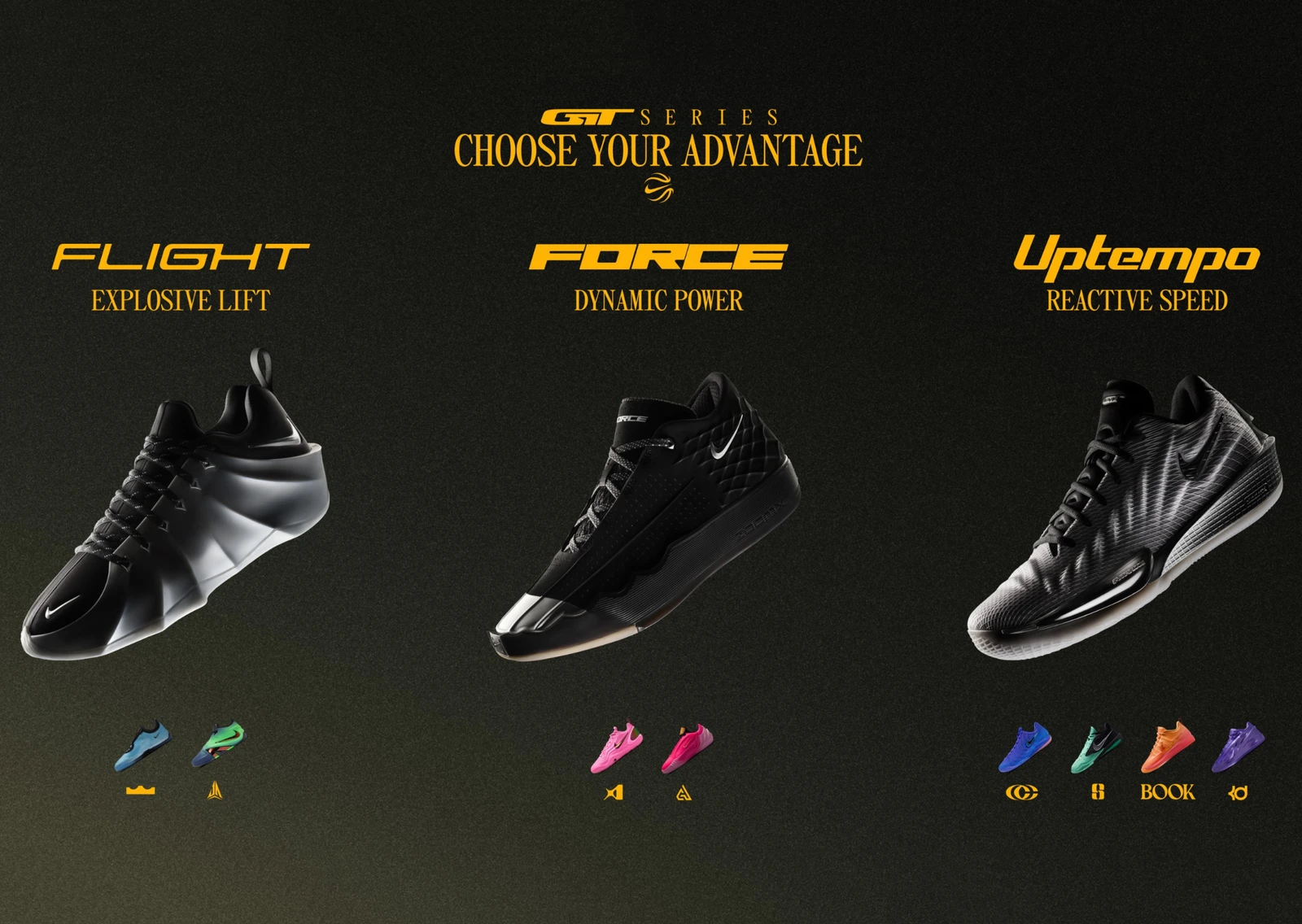 The full trio: Flight (explosive lift), Force (dynamic power), Uptempo (reactive speed). Image: Nike official press image, via Sole Retriever.
Why three shoes, and why now
Nike’s own framing, from its November 5 newsroom announcement, is that the modern game stopped respecting positions. A center brings the ball up; a guard posts up; everybody switches everything. So instead of designing by position — guard shoe, forward shoe, big shoe — Nike designed by movement: how a player jumps, how a player absorbs contact, how a player changes direction.
That gives you the three builds, in Nike’s words:
- Flight supports explosive lift and impact absorption upon landing.
- Force is engineered for dynamic power through stability and containment.
- Uptempo delivers the court feel and responsiveness required for reactive speed.
“Basketball is the soul of Nike,” said Ross Klein, VP and Creative Director of Nike Basketball, in the announcement. “This new foundation lets us bring the best of Nike Basketball performance and design to athletes in a way that’s more intuitive, more personal and built to evolve with the game.”
The heritage play is deliberate. In the late ’80s and early ’90s, Force, Flight and Uptempo were how Nike sorted its basketball line — different tools for different games. The G.T. series then revived the idea of building around a philosophy rather than a single star. This announcement fuses the two eras: the old names, the new foam, and a system that extends across the whole lineup rather than sitting on top of it as a separate collection.
That last part matters more than it sounds. The three builds are the foundation for all Nike Basketball footwear now, including signatures. Nike says its signature shoes are informed by the same builds, then tuned to each athlete. So the LeBron 24 is a Flight-family shoe. A’ja Wilson’s A’Two and Giannis Antetokounmpo’s Freak line sit in Force. Caitlin Clark’s Caitlin 1, Sabrina Ionescu’s Sabrina line, Devin Booker’s Book 2 and Kevin Durant’s KD 19 are Uptempo-family shoes. If you already own one of those, you already have a rough sense of which build fits you — and Nike is betting that makes the new trio easier to shop than a wall of unrelated models.
The three builds at a glance
| G.T. Flight | G.T. Force | G.T. Uptempo | |
|---|---|---|---|
| Job | Explosive lift, landing protection | Dynamic power, stability, containment | Reactive speed, court feel |
| Cushioning | Full-length Zoom Strobel + Cushlon 3.0 foam | ZoomX 3.0 foam | ZoomX 3.0 foam + Air Zoom Strobel + heel Air Zoom unit |
| Upper | Textile bootie with TPU cage | Synthetic armor upper, high- and low-top | Engineered mesh, low and light |
| Support | TPU cage, rubber traction outsole | TPU window and shank, rubber cup sole | TPU window and shank, Cushlon carrier, rubber outsole |
| Cut | Low-cut, sculpted metallic shell | High-top and low-top | Low-cut, closest to the floor |
| Faces | LeBron James, Ja Morant, AJ Dybantsa | Giannis Antetokounmpo, A’ja Wilson, Tyran Stokes | Devin Booker, Kevin Durant, Sabrina Ionescu, Caitlin Clark, Dylan Harper |
| Release | February 11, 2027, North America | February 11, 2027, North America | February 11, 2027, North America |
| Price | Not announced | Not announced | Not announced by Nike; $200 tentatively reported for the “Metallic Silver/Black” pair |
The price row deserves a pause. Nike has not published prices for any of the three. The $200 figure floating around for the Uptempo comes from Sneaker News and Sneaker Bar Detroit, tied to the “Metallic Silver/Black” pair (style code IR2018-002) that Dylan Harper has been wearing — it is a tentative report, not an official price. Treat every price you see before February as unconfirmed, and expect the three models to land at different tiers: the Uptempo’s reported $200, if it holds, would put it in line with the G.T. Cut 4’s territory rather than above it.
G.T. Flight: built to fly, and it looks it
Flight is the showpiece. It is the shoe for players whose games depend on vertical movement — attacking the basket, rising for rebounds, making plays above the rim — and Nike gave it a visual identity to match: a low-cut model with a sculpted metallic shell that reads, at a glance, like something built for speed in the air rather than on the floor. The early photos show a dark, almost armored look, with the metallic finish doing most of the talking.
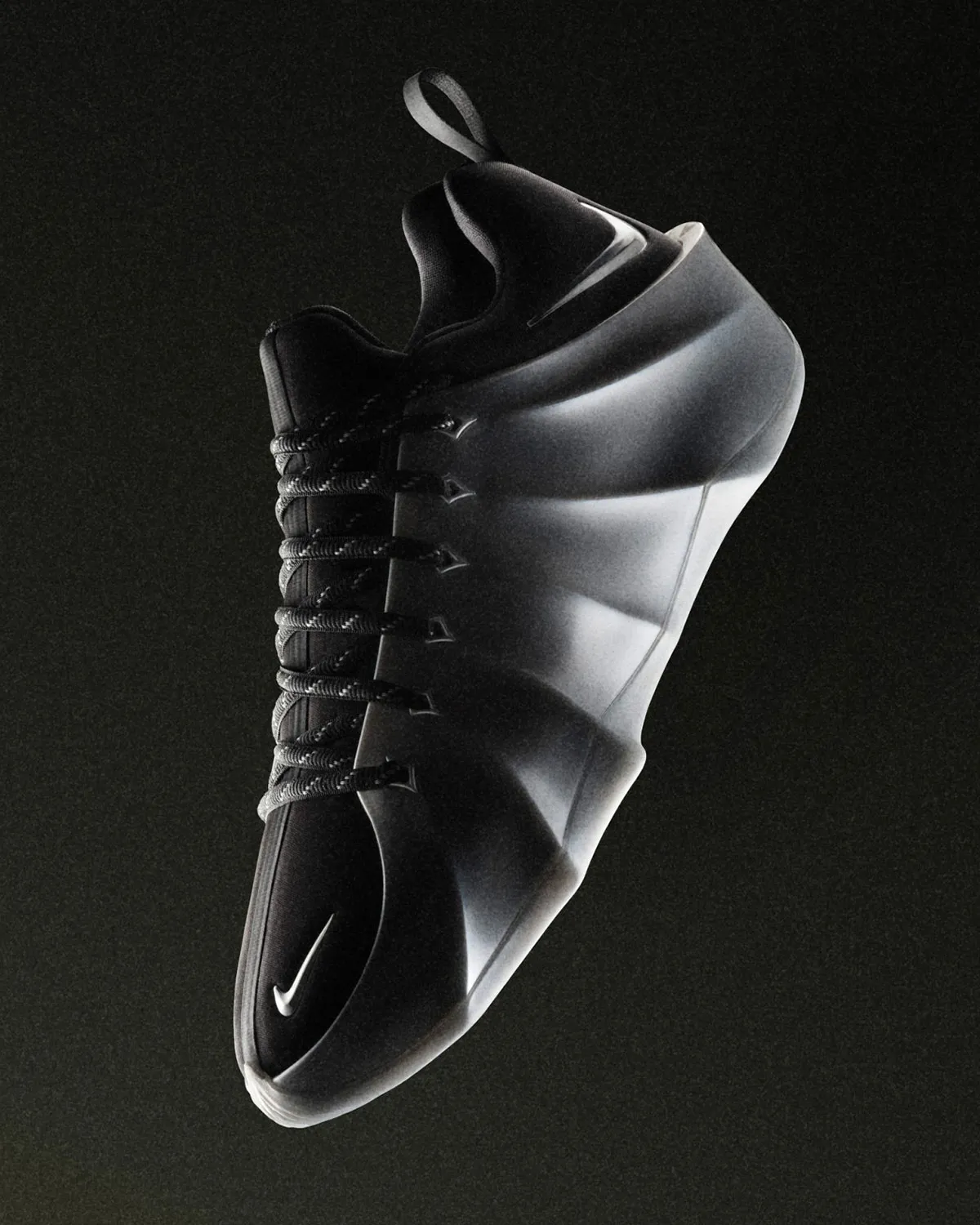 G.T. Flight: the metallic shell is the story. Image: Nike official press image, via Sneaker News.
Underneath, the cushioning stack is the interesting choice. A full-length Zoom Strobel — a full-length Air Zoom unit stitched into the strobel board, directly underfoot — sits on Cushlon 3.0 foam. That is a different philosophy from the other two shoes, which both use ZoomX 3.0. Cushlon is Nike’s workhorse foam: softer, more forgiving, better at soaking up repeated landings. Zoom Strobel adds the pop. The combination says: this shoe is about going up and coming down, over and over, without your knees filing a complaint.
The upper is a textile bootie with a TPU cage and a sock liner, plus a rubber traction outsole. No heavy armor here — the containment comes from the cage, not from a rigid shell, which should keep the shoe lighter than it looks.
The faces of Flight are LeBron James and Ja Morant, with young star AJ Dybantsa debuting the shoe. That is a deliberate piece of casting: the two most famous aerial players of their generations, plus the next one. If your game is built on the first step up rather than the first step past, Flight is Nike’s answer.
The open question is the one no photo can answer: how does a sculpted metallic shell actually feel on foot for a full game? The Flight is the most visually aggressive of the three, and visually aggressive shoes have a history of being heavier and stiffer than they look. The Cushlon 3.0 + Zoom Strobel stack is reassuring on paper — it is a landing-first setup — but the upper is where this shoe will pass or fail in wear-testing.
G.T. Force: the bully-ball shoe, and the most argued-about
If Flight is the showpiece, Force is the argument. It is engineered for players who rely on physicality, strength and sustained power — the players who win possessions by being immovable, then win the next one by being explosive anyway. It comes in both high-top and low-top versions, which already tells you Nike expects it to sell to two different buyers: the player who wants maximum containment, and the player who wants the Force look without the high collar.
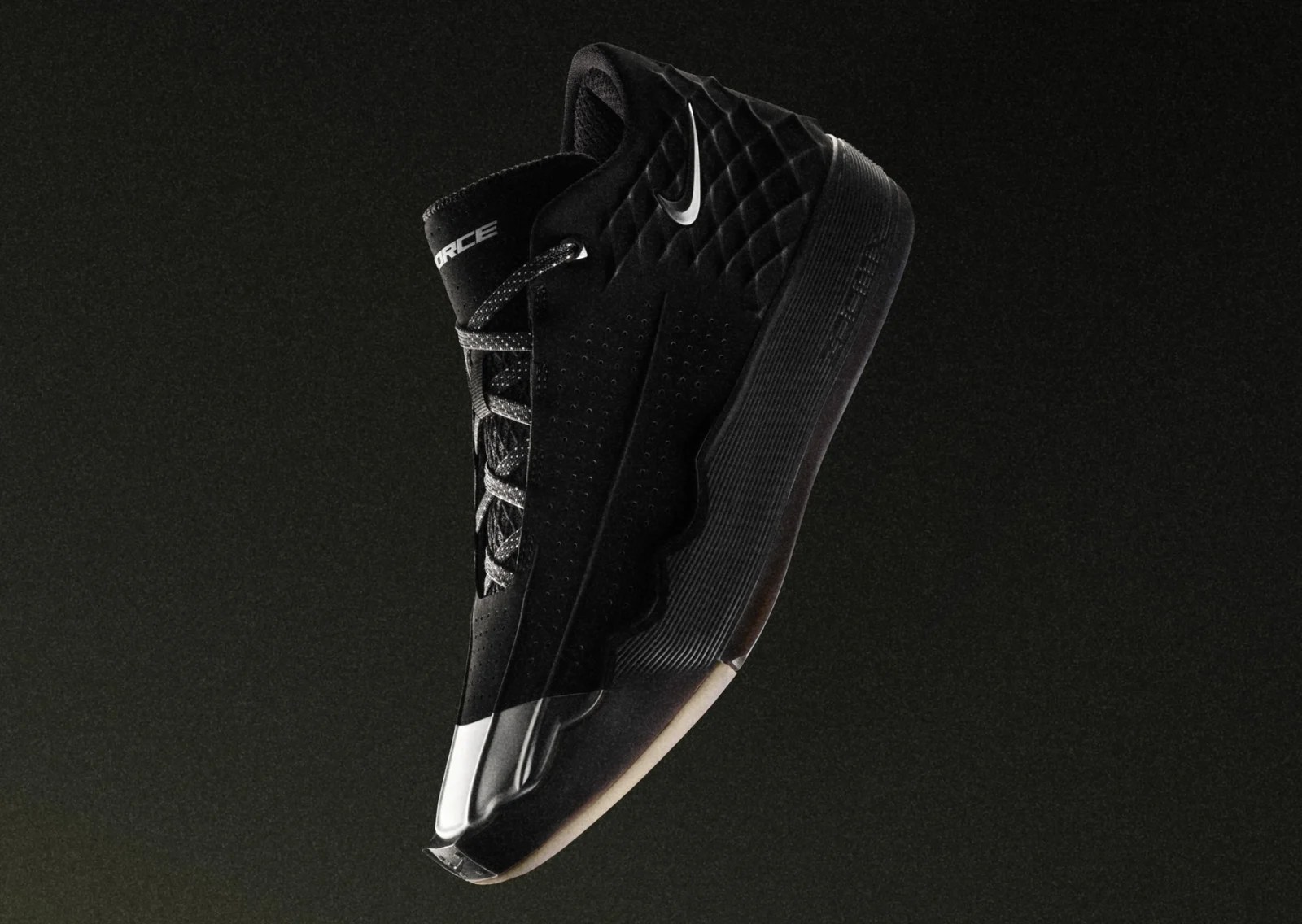 G.T. Force: quilted armor upper, TPU window and shank, rubber cup sole. Image: Nike official press image, via Sole Retriever.
The tech is the most premium-sounding of the three on first read: ZoomX 3.0 foam — Nike’s racing foam, the stuff from its marathon super-shoes, now in its third basketball generation — under a synthetic armor upper, with a TPU window and shank and a rubber cup sole. The armor upper is the point: it is meant to contain the foot when a 250-pound player plants, pivots and absorbs contact. The cup sole adds stability. Everything about the spec sheet says “this shoe holds its shape so you don’t have to.”
The faces are Giannis Antetokounmpo and A’ja Wilson, with Tyran Stokes debuting it — power players, both ends of the floor. And the design language borrows openly from the Air Force 1: a tough toebox, a flatter midsole, a silhouette that reads as heritage even before you know the spec sheet. One early write-up put it well: the Force takes its name and shape from the Air Force 1.
And yet the Force is the shoe the internet likes least so far. The comments under Bleacher Report Kicks’ announcement post were polarized: praise for the Uptempo and Flight silhouettes, widespread dismissal of the Force High and Low as unappealing or derivative, with comparisons to Foamposite, Kobe-era designs, Hyperdunk and Ja signatures. Some of that is just the internet being the internet — a bulky, armored high-top is an easy target next to two sleeker shoes. But there is a real tension here worth naming: the Force’s job is containment, and containment, done honestly, looks bulky. Nike chose not to hide that. Whether buyers reward the honesty is a February question.
The other honest caveat: ZoomX is a wonderful foam and a fragile one. It is soft, bouncy and light, and in running shoes it is famously less durable than firmer foams. Nike’s ZoomX 3.0 is presumably formulated for court use, and the armor upper and cup sole are there to protect it — but durability is the number-one thing to watch in the first wave of wear-test reviews. If the Force’s foam packs out after a month of hard play, the spec sheet won’t save it.
G.T. Uptempo: the one everyone already loves
The Uptempo is the crowd favorite, and it is not close. It is the lightweight, low-to-the-ground shoe for quickness, precision and court feel — the guard’s shoe in a lineup that claims to have moved past positions — and it has two advantages the other two don’t: it has already been seen on court, and it looks the most like a shoe people already know they like.
Dylan Harper has been wearing the Uptempo throughout the 2026–27 season with the Spurs, including the “Metallic Silver/Black” pair (IR2018-002).
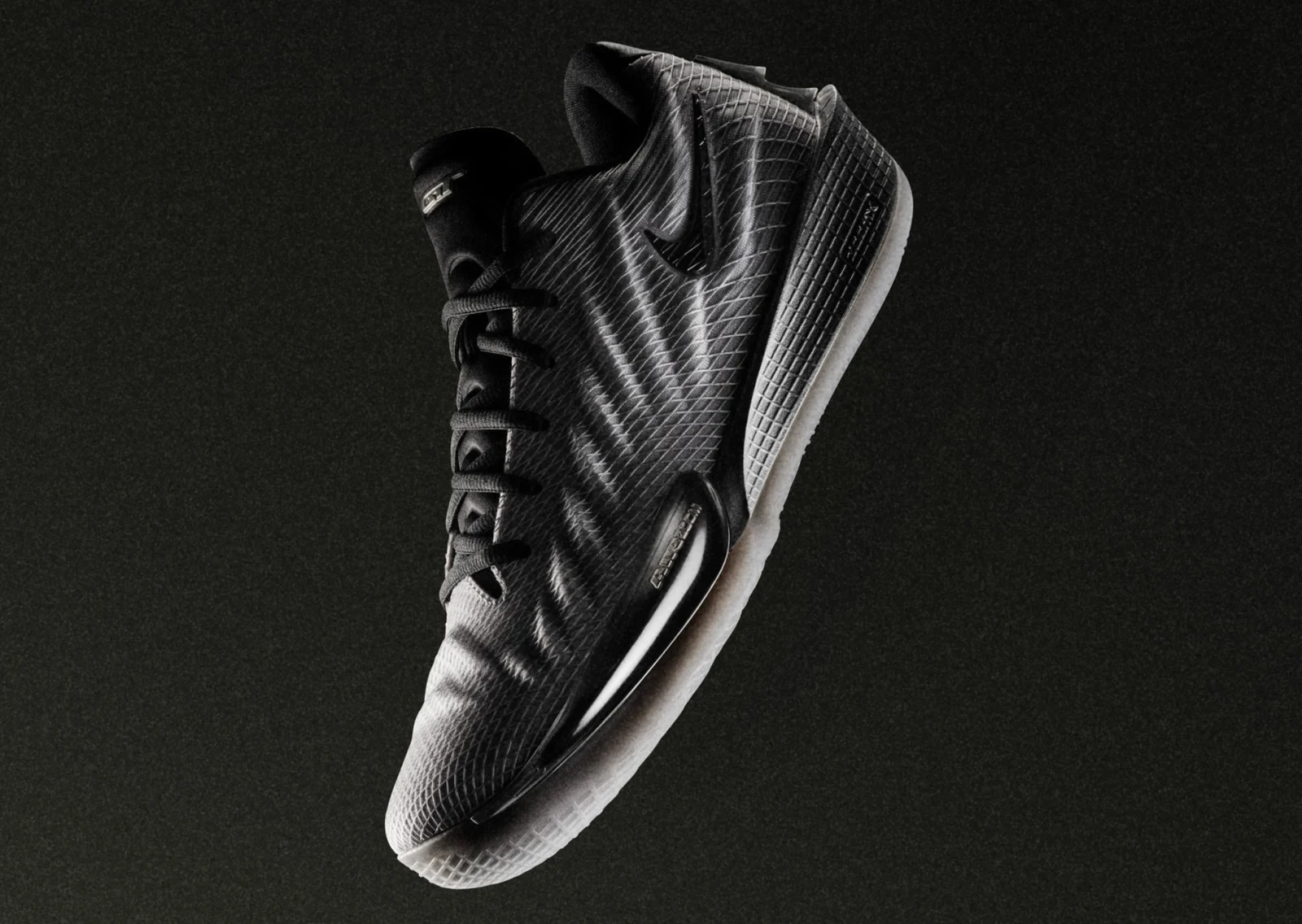 G.T. Uptempo: woven texture, glossy midfoot accent, visible Air Zoom. Image: Nike official press image, via Sole Retriever.
That matters, because it means the Uptempo is the only one of the three with any real on-court mileage in public before launch — not a formal review, but a season of NBA games is a better preview than a studio photo. The design fits closer to the classic G.T. Cut look: a one-piece upper, a streamlined shape, a low-profile cut, a woven texture with a glossy midfoot accent. It looks fast standing still, which is exactly what Nike’s copy promises: “both looks and feels fast.”
The tech stack is the most complete of the three. ZoomX 3.0 foam, an Air Zoom Strobel, and an additional Air Zoom unit in the heel, on a Cushlon carrier, with an engineered mesh upper, a TPU window and shank, and a rubber outsole. That is three layers of cushioning technology doing three different jobs: ZoomX for energy return, the Strobel for underfoot responsiveness, the heel Air Zoom for impact on hard plants and stops. Nike pitches it as the best court feel of the three, and on paper that is the easiest claim to believe — the stack is built low, so you sit closer to the floor, and the mesh upper keeps weight down.
The faces are the deepest bench of the three: Devin Booker, Kevin Durant, Sabrina Ionescu and Caitlin Clark, plus Harper. That is four of the most skilled, most precision-dependent players in basketball. The message is clear: Uptempo is for players who win with processing speed — seeing the play, reacting, creating separation in a step — rather than with raw vertical or raw power.
If there is a default recommendation in this trio, it is the Uptempo, and the early reaction agrees. It is also the only one with a reported price — $200, tentative, for the Metallic Silver/Black pair — which, if it holds, makes it the easiest of the three to justify. The risk is the familiar one for low, light, ZoomX-based guards’ shoes: durability and support for bigger players. If you are 220 pounds and play bully ball, Nike is pointing you at the Force for a reason. The Uptempo is not trying to be that shoe.
Foam cheat sheet: what ZoomX, Cushlon and Zoom Strobel actually do
Nike’s naming makes this harder than it needs to be, so here is the plain version:
- ZoomX is Nike’s lightest, bounciest foam, borrowed from marathon racing shoes. It returns the most energy per step, and it is also the softest and least durable. It shows up in the Force and the Uptempo — the two shoes where responsiveness matters most — and not in the Flight, which chose landing protection instead.
- Cushlon 3.0 is the workhorse: softer and more forgiving than ZoomX, better at absorbing repeated impact, less explosive. It is the Flight’s main foam, and it also appears as a carrier layer in the Uptempo.
- Zoom Strobel is not a foam at all. It is a full-length Air Zoom cushioning unit stitched into the strobel board — the layer directly under your foot. “Full-length” means heel to toe; “Air Zoom Strobel” in the Uptempo is the same idea. It gives you responsiveness right underfoot, without raising the stack height much.
- Air Zoom unit (heel) is the familiar pressurized air bag, in this case an extra one in the Uptempo’s heel for hard plants and stops.
Read the three stacks as three philosophies: Flight says “protect the landing” (Cushlon + full-length Strobel). Force says “return the energy, contain the foot” (ZoomX + armor). Uptempo says “feel everything, waste nothing” (ZoomX + Strobel + heel Air Zoom, built low). None of these is objectively best — they are best for a job.
What the internet thinks so far
The announcement landed on November 5, and the first 24 hours of reaction were polarized in a way that actually tells you something.
The Bleacher Report Kicks post announcing the trio drew strong, split reactions: frequent praise for the Uptempo and Flight silhouettes, widespread dismissal of the Force High and Low as unappealing or derivative. Commenters compared the new models to legacy lines — Foamposite, Kobe signatures, Hyperdunk, Ja Morant’s shoes — and a vocal minority used the launch to rehearse a broader complaint about Nike’s business and the G.T. naming scheme, calling for older models to come back instead.
Complex’s guide framed it more usefully, as a buying question: which G.T. sneaker should you buy? Flight for jumping and explosive movement (Ja, LeBron), Uptempo for speed and change of direction (Booker, KD, Sabrina), Force for strength and power (Giannis, A’ja). That is the whole pitch, compressed into one carousel, and it is probably how most people will actually shop these shoes.
Two things to keep in perspective. First, nobody in these comment threads has worn the shoes. The reaction so far is a design reaction — to photos, in dark, moody lighting, shoes floating against black backgrounds. Design reactions are real information about desirability, but they are not performance information. Second, the polarization itself is a sign Nike did something distinctive. The G.T. Cut era was safe and samey; these three shoes are not. People arguing about them is, for Nike, the point.
Which build are you?
Forget positions. Answer these three questions instead:
- Do you win by going up? If your best possessions end above the rim — rebounds in traffic, blocks, finishes through contact — and your knees feel every landing, start with the Flight. The Cushlon 3.0 + full-length Zoom Strobel stack is built for exactly that cycle.
- Do you win by going through? If you play bully ball, set the tone physically, guard multiple positions and need your shoe to hold its shape when you plant at full force, start with the Force. Try the high-top first if you want maximum containment; the low-top if you want the look and the ZoomX without the collar.
- Do you win by going first? If your game is first-step quickness, change of direction, creating separation in a step and feeling the floor under you, start with the Uptempo. It is the lowest, lightest and most complete tech stack of the three, and the early favorite for a reason.
And if you already own a signature shoe, Nike has done the mapping for you: LeBron 24 or Ja 4 means you are already a Flight player; the Freak line or A’Two means Force; Book 2, KD 19, the Sabrina line or Caitlin 1 means Uptempo. That is not marketing fluff — it is the most useful shortcut in the whole announcement.
What could go wrong
A long first look should end with the open questions, not bury them:
- Prices. Nike has not announced any. The $200 Uptempo figure is tentative, from secondary sources. If the Flight or Force land above $200, the value conversation changes completely — especially against the G.T. Cut 4 at $200–$210 and the rest of a crowded $130–$210 market.
- No wear tests yet. Everything above about feel, weight, durability and traction is inferred from spec sheets and photos. The Force’s ZoomX durability, the Flight’s metallic shell comfort, the Uptempo’s support for heavier players — all untested until February.
- The Force’s design problem is real. The early reaction says it plainly: the armored high-top looks derivative to a lot of people. Nike is betting performance buyers will not care. That bet has failed before — the Hyperdunk era is full of great shoes people didn’t buy because they didn’t love looking at them.
- Sizing and fit. A textile bootie (Flight), an armor upper (Force) and an engineered mesh upper (Uptempo) will fit three different ways. Expect the usual Nike advice to apply — try them on, and don’t assume your G.T. Cut size carries over — until real fit reports exist.
- The global launch lags. North America gets February 11, 2027; the rest of the world follows on an unannounced date. Resale will notice before retail does.
Verdict: the system is the story
The individual shoes are good-looking and well-specced, and the Uptempo in particular looks like a genuine hit — the right tech, the right look, the right athletes, a season of on-court previews before it even goes on sale. But the story here is not one shoe. It is that Nike stopped selling basketball shoes as a shelf of unrelated models and started selling them as a system: three builds, three jobs, one framework that stretches from a $130 team shoe to a signature.
That is a bigger swing than it looks, and it is a bet on something the last few years of Nike Basketball arguably lost: the idea that a player should be able to walk into a store, answer one question about how they play, and walk out with the right shoe. Flight, Force and Uptempo are Nike’s attempt to make that question easy again. Whether the shoes live up to the system is a February question — but as a piece of design thinking, and frankly as a piece of theatre, it is the most interesting thing Nike Basketball has done in years.
The facts, as of November 6, 2026: unveiled November 5, 2026; on sale February 11, 2027 in North America at nike.com and select retailers, global launch to follow; prices not announced by Nike (Uptempo $200 is a tentative secondary report, not official); G.T. Flight (full-length Zoom Strobel + Cushlon 3.0), G.T. Force High/Low (ZoomX 3.0 + armor upper), G.T. Uptempo (ZoomX 3.0 + Air Zoom Strobel + heel Air Zoom). Prices and availability are a snapshot of what was known on November 6, 2026 and are subject to change.
Sources: Nike Newsroom — Nike Basketball Reintroduces Flight, Force and Uptempo · Sneaker News — Nike GT Flight, Force, Uptempo 2027 · Sole Retriever — Nike Basketball Debuts the GT Flight, Force, and Uptempo · Sneaker News — Nike GT Uptempo “Metallic Silver/Black” · Complex Sneakers / Bleacher Report Kicks — announcement reaction
Share on
Twitter Facebook LinkedIn☕ Buy me a coffee! 💝
If you found this article helpful, consider buying me a coffee to support my work! 🚀