
Ripple-65B: a 65B dense model just beat trillion-parameter MoEs at terminal coding
Published:
On November 4, 2026, Ricursive Intelligence — a chip-design startup — released Ripple-65B Preview: a 65-billion-parameter dense Transformer, Apache 2.0, trained from scratch on 12 trillion tokens. Dense means every parameter fires on every token; MoE (mixture-of-experts) models activate only a slice per token. The headline number, vendor-reported: 80.52 on Terminal-Bench 2.1, an agentic coding benchmark where the model solves real tasks inside a terminal — ahead of Reflection Beam 501B (80.1), Meta Muse Spark Open 816B (76.4), Thinking Machines Inkling 975B (63.8), and NVIDIA Nemotron 3 Ultra 550B (56.4).
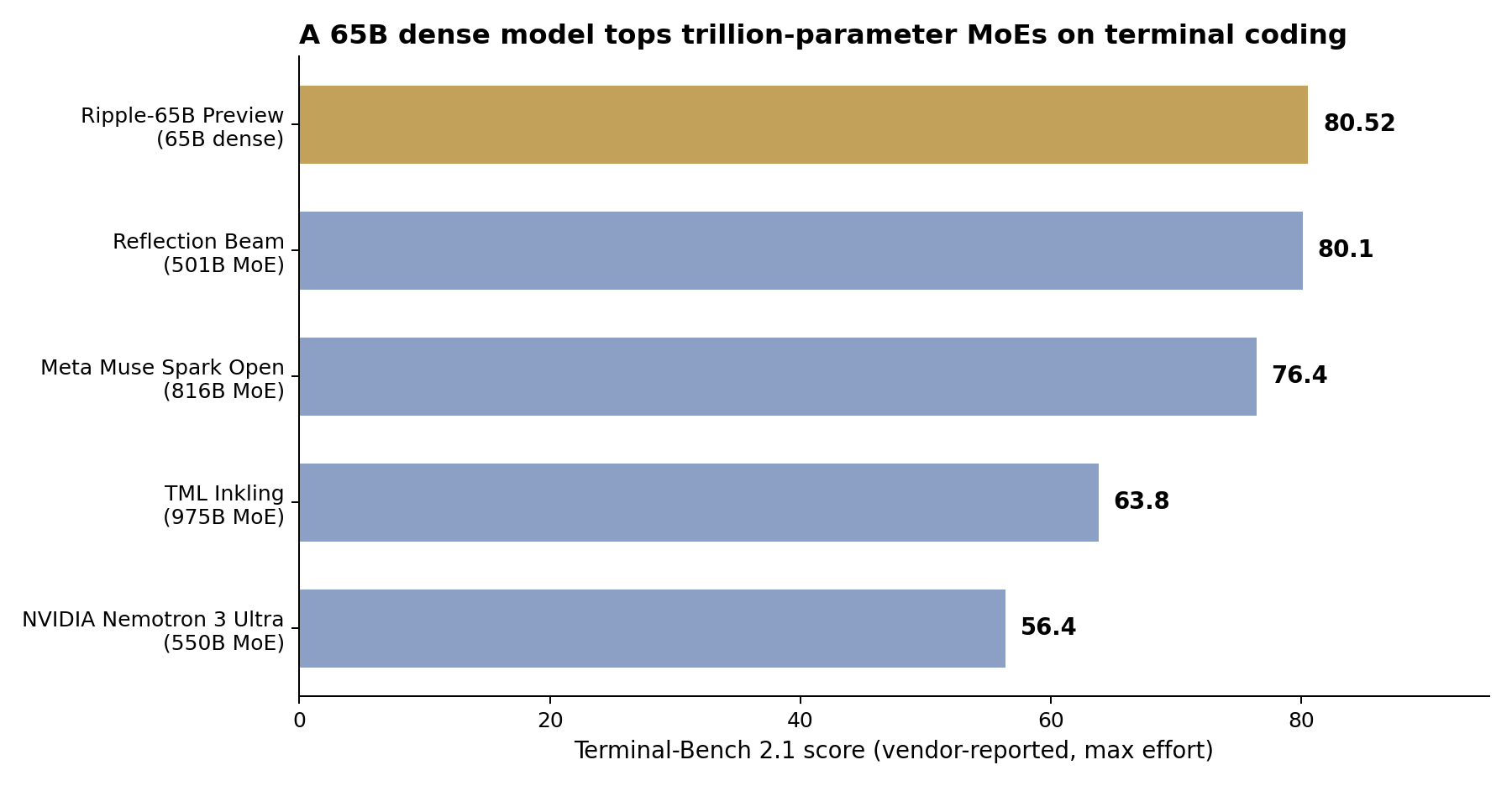
The numbers, from Ricursive’s own model card
All figures below are from the Hugging Face model card (ricursiveAI/Ripple-65B-Preview), instruct BF16, maximum effort. They are vendor-reported — no independent evaluation had surfaced at publication time.
| Benchmark | Ripple-65B | Reflection Beam 501B | Muse Spark Open 816B | Inkling 975B | Nemotron 3 Ultra 550B |
|---|---|---|---|---|---|
| Terminal-Bench 2.1 | 80.52 | 80.1 | 76.4 | 63.8 | 56.4 |
| SWE-bench Pro v2.0 Hard | 63.8 | 60.4 | 57.1 | 47.2 | 40.1 |
| SWE-bench Verified | 81.8 | 81.8 | 81.2 | 76.4 | 66.8 |
| DeepSWE 1.1 | 54.4 | 45.2 | 46.9 | 43.0 | 35.4 |
| GPQA Diamond | 79.3 | 79.3 | 77.2 | 77.0 | 74.6 |
| SciCode | 50.0 | 52.8 | 49.1 | 46.1 | 44.6 |
| MCP Atlas | 36.7 | 34.0 | 23.2 | 21.5 | 17.5 |
| AIME 2025 | 95.8 | 99.2 | 96.5 | 94.8 | 94.8 |
| AIME 2026 | 92.1 | 96.5 | 95.3 | 93.0 | 90.0 |
Read the table honestly: Ripple leads or ties on six of nine, but Beam still leads on SciCode and both AIME years. The win is real on agentic coding, not universal.
How a 65B model got there: efficiency, not scale
The launch blog (ricursive.com/ripple) tells the more interesting story — the budget, not the benchmark:
- $32M full R&D cost, including the pretraining ladder, data mixing, evals, synthetic data, and the final hero run. Ricursive calls it one-tenth the cost of the previous open-weight SOTA on agentic coding (their estimate).
- 1.4M RL rollouts to reach 80.5 on Terminal-Bench 2.1 — roughly 70x fewer than Reflection Beam’s ~100M.
- 16x compute efficiency on code versus the Olmo 3 ladder it started from, via careful small-scale laddering (architecture, data mix, SFT/RL recipe) before the hero run.
- 40% MFU through pretraining and post-training with simple sharding, no custom kernels, no quantization — the dense architecture was chosen explicitly to cut infrastructure complexity.
- The recipe: 12T pretraining tokens (9.4T at 8K context, then 2.6T midtraining at 64K), code upsampled in the data mix (22–26%), 6.5B tokens of SFT, 700 RL steps at 128K. Thin-and-deep shape: 80 layers, d_model 5,120, sliding-window attention 4,096 with a 3:1 SWA-to-global ratio, gated attention, global NoPE, value residuals.
The mechanism is the thesis: the last three years of open-weights progress were mostly “activate a bigger slice of a bigger MoE.” Ripple says the same terminal-coding score is reachable by spending the compute on recipe iteration instead of parameter count — and the resulting model is 15x smaller than the ~1T-parameter class it ties.
The caveats that matter
Praise first, then the sharp part — three caveats, all from Ricursive’s own pages:
- The vendor publishes two different tables. The Hugging Face card and the Together AI listing disagree on several numbers (GPQA Diamond 79.3 vs 85.2, SciCode 50.0 vs 39.4, AIME 2025 95.8 vs 98.3) — apparently different harness settings. I used the Hugging Face table throughout; do not mix the two. A vendor that can’t keep its own scoreboard consistent is a reason to run your own 20 tasks, not to quote the headline.
- The 1M context is extrapolation, not training. The model was trained to 128K context; 1M is what it extrapolates to. Every agent benchmark above was run at 128K max with trajectory summarization near the limit, and Together’s hosted spec lists 128K. Do not plan 1M-context work on this model.
- Preview, light post-training, text-only, mostly English. The repo also carries a custom-code tag, so loading it requires trusting remote code. BF16 weights are ~130GB; the NVFP4 build (~57GB) is the one that fits a DGX Spark.
What to do Monday morning
- Replay, don’t quote. If you run open-weight coding agents, put Ripple-65B on 20 of your own terminal tasks this week (Together AI serves it at $0.20 input / $0.60 output per million tokens, $0.02 cached). Tie rule: if it lands within 5 points of your current 500B+ MoE on your tasks, switch the default — the serving footprint (130GB BF16, one 8-GPU node) and the token price make the tie a win.
- Price per completed task, not per token. The $32M build cost is Ricursive’s story; yours is cost per solved task at fixed effort. Track it for two weeks before any renewal decision.
- Cap context at 128K in your test plan. The 1M number is extrapolation. Any task that needs more is a different evaluation.
The debate
If a 65B dense model ties a 500B MoE on your own terminal tasks, is “bigger” still a strategy — or just a habit? The MoE era’s bet was that sparsity buys capability per dollar. Ripple’s bet is that recipe buys it cheaper. One of those bets is now testable for $0.20 per million input tokens, and the answer on your tasks is worth more than either vendor’s table.
Sources
- Ricursive Intelligence, Ripple-65B Preview model card (Hugging Face, Nov 4, 2026): https://huggingface.co/ricursiveAI/Ripple-65B-Preview
- Ricursive Intelligence, launch blog: https://www.ricursive.com/ripple
- Together AI, Ripple-65B-Preview pricing and specs: https://www.together.ai/models/ripple-65b-preview
- Secondary coverage with additional detail (DepthGrid, Nov 6, 2026): https://www.depthgrid.in/2026/11/ricursive-ripple-65b-preview-open-weights-benchmarks.html
Share on
Twitter Facebook LinkedIn☕ Buy me a coffee! 💝
If you found this article helpful, consider buying me a coffee to support my work! 🚀